The Role of Leadership in Workplace Violence Prevention

Every framework that governs this work names the same first requirement. Not training, not a policy. Management commitment. Here is what that actually means once the budget is already approved.
Most executives I've worked with already believe workplace violence prevention matters. They've approved the budget, signed the policy, and asked good questions in the meeting where the program was proposed. That's not a low bar, and it's not nothing. It's also not the whole of what OSHA, the Joint Commission, and every serious framework in this category mean when they name leadership as an essential element. The gap between the two is worth a closer look, because closing it costs far less than the program you've already funded.
I design workplace violence strategy for a living. I built and ran healthcare security and workplace violence strategy for Ascension, the fifth-largest health system in the United States, reaching every market where that system operates, and I work the same problem now as chief operating officer at Vistelar. Before any of that, I started my healthcare journey on night shifts in one of the busiest emergency departments in Birmingham, watching what changed on a unit when a director actually showed up and what stayed exactly the same when one didn't.
What does leadership mean in workplace violence prevention?
Leadership in workplace violence prevention means visible commitment from senior leaders, not only funding. Every major framework, including OSHA's guidelines and the Joint Commission's workplace violence requirements, names it as an essential element.
Funding a program is the entry ticket every framework requires. Visible commitment is the part that turns the entry ticket into a culture, and it's the same commitment you've already shown, made visible, not a bigger one.
This isn't a call to do more. It's a case for where the attention you're already giving this issue needs to show up next, and for what you personally get back when it does.
KEY TAKEAWAYS
-
Every major framework names leadership first, not last. OSHA structures its recommended violence-prevention program around five elements and lists management commitment and worker participation as the first of them, ahead of hazard analysis, hazard control, training, and recordkeeping. The Joint Commission's workplace violence standard (NPG.02.04.01) requires the program be led by a designated individual, not merely funded by one.
-
Visible leadership presence was associated with a stronger frontline safety climate. A 2008 study of leadership WalkRounds across seven Massachusetts hospitals (Frankel and colleagues) found that only two implemented leadership WalkRounds rigorously and consistently. In those two, frontline safety-climate scores rose by 15 and 10 percentage points, and the share of care areas with weak safety climate dropped by more than two thirds.
-
One of the strongest workplace violence trials tested a leadership behavior, not a purchase. In a 2017 randomized controlled trial (Arnetz and colleagues), unit supervisors received their own unit's violence data, starting with a single walkthrough capped at 45 minutes, and built a prevention plan with staff. Six months later, violent events on those units were about half as frequent as on comparison units.
-
A 2026 BMC Health Services Research study of general practices (Mache and colleagues) found leadership was a central factor in whether prevention efforts were carried out consistently. Visible commitment, active involvement, and resource provision from practice leaders strengthened staff adherence and confidence. Where leadership registered only severe incidents and treated verbal aggression as routine, staff learned to do the same.
-
The payoff for visible commitment lands on a different number for every seat at the table. Retention, cost exposure, quality scores, and regulatory standing all move with leadership visibility, which means this isn't one more competing priority for the C-suite. It's a lever the chief financial officer, the chief human resources officer, clinical leadership, and the chief executive each pull for their own reasons, and all four reasons point the same direction.
Why do OSHA and the Joint Commission name leadership first?
OSHA and the Joint Commission name leadership first because the other program elements depend on it.
OSHA's guidelines for preventing workplace violence in healthcare organize a program around five elements:
-
Management commitment and employee participation
-
Worksite analysis
-
Hazard prevention and control
-
Safety and health training
-
Recordkeeping and program evaluation
Commitment is listed first, and the order isn't alphabetical. The other four elements depend on it. OSHA describes that commitment as including "the endorsement and visible involvement of top management." A worksite analysis someone senior didn't ask for doesn't get acted on. Hazard controls someone senior didn't fund don't get installed. Training someone senior doesn't reference again after the kickoff reads, correctly, as a one-time event.
The Joint Commission's workplace violence prevention requirements (NPG.02.04.01) make the same point in different language, requiring that the program be led by a designated individual, developed by a multidisciplinary team, and reported to the governing body, rather than simply existing on paper with an owner of record. Leadership isn't an item on the checklist next to training and reporting. It's the reason the rest of the checklist gets maintained past its first year.
Too often, funded infrastructure fades without the right governance to sustain it. A compliance program asks whether the training happened. A culture asks whether anything changed, and it answers that question through what leadership funds, governs, and holds people accountable for. Every framework in this category is, underneath its specific language, asking the same question: Is someone senior enough still paying attention after the launch event?
What does visible leadership look like, and how is it different from funding?
Visible leadership means senior leaders show up where staff can see them and act on what staff raise. Funding alone does not do that.
A 2008 study across seven Massachusetts hospitals tested leadership WalkRounds, a practice of senior leaders visiting units on a regular schedule to talk directly with frontline staff about safety concerns. Only two of the seven hospitals implemented it rigorously and consistently over the study period. In those two, frontline-reported safety climate rose from 62% to 77% in one hospital and from 46% to 56% in the other, and across the care areas in those two hospitals, the share scoring below a healthy safety-climate threshold fell from nearly half to about one in seven.
The WalkRounds study matters for a reason beyond the percentages. Every hospital in that study signed up to try WalkRounds. Two never got them going, after a leadership change or a lack of resources. Four held the rounds every week. What separated the two that moved the needle was follow-through: their leaders also tracked what staff raised and acted on it, rather than letting the rounds become one more meeting on a senior leader's calendar.
A 2026 qualitative study of general practices found the same pattern specific to workplace violence. Leadership emerged as a central factor in whether prevention efforts were carried out consistently. Resources mattered, but so did whether commitment and involvement were visible to staff. One participant put it plainly: "When the practice owner takes time to discuss safety, ... we all notice it." Where leadership instead registered only the most severe incidents and staff described leaders as out of touch with everyday work realities, verbal aggression got quietly reclassified as something that just came with the job.
"One of the best-evidenced interventions in this field started with a 45-minute walkthrough and data the hospital already owned."
Casey Goldschmidt, CEM
The 45-minute walkthrough comes from one of the strongest controlled trials in this literature, a 2017 randomized controlled trial by Arnetz and colleagues, and it points to the same place from a third direction. The intervention wasn't a curriculum. Each unit supervisor received that unit's own violence data, benchmarked against the whole hospital system, and built a plan with staff around it. What made the difference was management attention pointed at real numbers, not a purchase order.
Why does visible leadership matter to each executive?
Visible leadership commitment pays off on a different measure for each executive: cost for the chief financial officer, retention for the chief human resources officer, quality for clinical leaders, regulatory standing for counsel and compliance, and culture for the chief executive.
Visible commitment does not ask an executive to become a safety officer. It asks for something smaller and more specific: that the attention already being paid to this issue in budget meetings shows up occasionally where staff can see it too. Where that attention needs to show up, and what it's worth, isn't identical across a leadership team. It lands on a different number depending on which seat you sit in, and naming that directly is more useful than treating "the C-suite" as one undifferentiated audience.
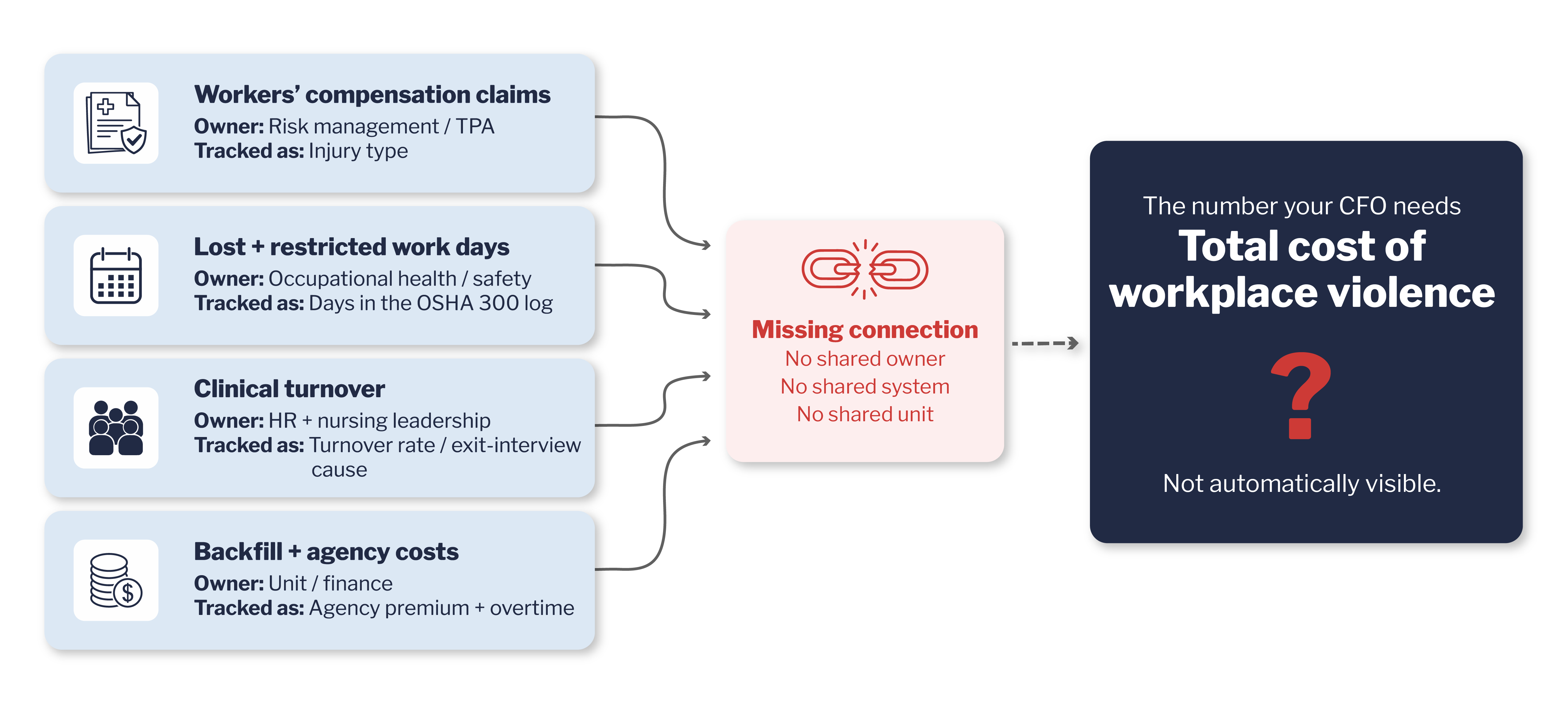
For the chief financial officer, the case is the most literal. The line-item cost model in What Workplace Violence Actually Costs a Hospital: A Line-Item Breakdown puts a hospital's exposure between $233 and $1,121 per employee per year, depending on how much of the cost is attributed to violence, and separately prices one retained nurse at roughly $74,200 in avoided replacement and backfill cost. Visible leadership commitment doesn't add a new line to that model. It's the variable that decides whether the dollars already committed to the program produce those numbers or sit on a shelf next to a training-completion report nobody asks to see again.
For the chief human resources officer, the imperative runs through retention and reporting culture directly. Staff decide whether an organization's commitment is real by watching what leadership does after the policy is signed, not by reading the policy itself. A 2023 study of nurses found that a strong violence-reporting culture, on its own, intensified rather than softened the link between violence and burnout. Reporting without a visible response is one likely reason, which makes visible commitment more than adjacent to the turnover number on a chief human resources officer's dashboard. It's a direct input to it. See Building a Culture Where Staff Actually Report Incidents.
For the chief nursing officer and the chief medical officer, the stake is quality, not only safety. A 2023 cross-sectional study of 3,132 hospital staff with patient contact at one academic medical center found that higher patient safety culture was associated with lower odds of workplace violence, with teamwork across units and quality of handoffs among the strongest individual contributors. It's a single site and an association rather than a demonstrated cause, but staff safety and patient safety aren't competing line items in that finding. They're the same organizational conditions, measured twice.
For general counsel and the chief compliance officer, the framework recommendation itself is the imperative. OSHA recommends visible involvement from top management, and the Joint Commission requires a designated program leader who reports to the governing body. A program that's funded but not visibly led is exactly the kind of gap a surveyor, or opposing counsel, is trained to find. A binder answers whether the training happened. It does not answer whether anyone was watching afterward, and that second question is the one that gets asked in a deposition.
For the chief executive, all four of those stakes report up to one place. A board doesn't ask whether a policy exists. It asks whether the organization's stated values and its actual culture match, and workplace violence prevention is one of the few places where that question gets tested against hard numbers instead of a survey response. Visible commitment at the top is what keeps the answer to that question the one leadership already believes it is.
The bottom line
Every framework in this category names leadership as an essential element because the other elements don't sustain themselves without it. That isn't a criticism of the executives reading this. Most already care, already fund the program, and already ask the right questions in the room where it gets approved. The evidence simply points at where that same care needs to become visible next: on the floor, in the huddle, in the follow-up question about last month's numbers, not only in the budget line that made the program possible in the first place. And it points at a different specific payoff for every seat at that table, which is exactly why this can't be delegated to one office and forgotten by the rest of the C-suite.
The signature on the budget is the beginning of the requirement, not the end of it.
Frequently Asked Questions
OSHA's guidelines for preventing workplace violence in healthcare list management commitment and employee participation as the first of five core program elements, ahead of worksite analysis, hazard control, training, and recordkeeping. The Joint Commission's workplace violence prevention standard requires that the program be led by a designated individual and developed by a multidisciplinary team, rather than existing only as a funded policy.
Funding and policy approval are necessary but not sufficient on their own. A 2008 study of leadership WalkRounds across seven Massachusetts hospitals found that hospitals that held rounds consistently and acted on what staff raised saw measurable gains in frontline safety climate, while simply endorsing the concept without consistent execution did not produce the same result.
Published research supports this: visible executive involvement was associated with a stronger frontline safety climate. A 2008 study across seven Massachusetts hospitals found that the two hospitals implementing leadership WalkRounds rigorously saw frontline safety-climate scores rise by 15 and 10 percentage points, and a 2026 qualitative study of general practices found visible leadership commitment to be a central factor in whether violence-prevention efforts were carried out consistently.
In a 2023 study of 3,132 staff at one academic medical center, a stronger patient safety culture was associated with lower odds of workplace violence, which suggests the conditions that reduce clinical errors may reduce violence as well. Visible leadership commitment also connects directly to retention and reporting-culture outcomes, both of which carry a measurable dollar value documented in What Workplace Violence Actually Costs a Hospital and Workplace Violence and Nurse Turnover.
Small, specific, repeatable behaviors: attending a unit debrief occasionally, asking a unit manager what the safety data showed last month, referencing workplace violence prevention by name in a town hall, and being present, unscheduled, on units rather than only in committee meetings about the program. The evidence points to consistency of presence, not size of gesture, as what changes frontline perception.
Every framework cited in this article, OSHA's guidelines and the Joint Commission's workplace violence standard among them, places accountability at a level senior enough to fund, govern, and sustain the program across budget cycles, not only at the unit level. Frontline and unit leadership execute the program daily; the standards expect senior leadership to stay involved past the launch.
Sources
-
Arnetz, J. E., Hamblin, L., Russell, J., Upfal, M. J., Luborsky, M., Janisse, J., & Essenmacher, L. (2017). Preventing patient-to-worker violence in hospitals: Outcome of a randomized controlled intervention. Journal of Occupational and Environmental Medicine, 59(1), 18–27. https://doi.org/10.1097/JOM.0000000000000909
-
Frankel, A., Grillo, S. P., Pittman, M., Thomas, E. J., Horowitz, L., Page, M., & Sexton, B. (2008). Revealing and resolving patient safety defects: The impact of leadership WalkRounds on frontline caregiver assessments of patient safety. Health Services Research, 43(6), 2050–2066. https://doi.org/10.1111/j.1475-6773.2008.00878.x
-
The Joint Commission. (2026). 2026 hospital National Performance Goals (NPGs). https://digitalassets.jointcommission.org/api/public/content/8d49c3ffa9934ffda2ff83b5ad860ea7
-
Kim, S., Kitzmiller, R., Baernholdt, M., Lynn, M. R., & Jones, C. B. (2023). Patient safety culture: The impact on workplace violence and health worker burnout. Workplace Health & Safety, 71(2), 78–88. https://doi.org/10.1177/21650799221126364
-
Kim, S., Lynn, M. R., Baernholdt, M., Kitzmiller, R., & Jones, C. B. (2023). How does workplace violence–reporting culture affect workplace violence, nurse burnout, and patient safety? Journal of Nursing Care Quality, 38(1), 11–18. https://doi.org/10.1097/NCQ.0000000000000641
-
Mache, S., Bernburg, M., Würtenberger, A., Groneberg, D. A., & Harth, V. (2026). Violence prevention in primary care: A qualitative study of barriers and facilitators in general practice. BMC Health Services Research, 26, Article 946. https://doi.org/10.1186/s12913-026-15086-w
-
Occupational Safety and Health Administration. (2016). Guidelines for preventing workplace violence for healthcare and social service workers (OSHA 3148-06R). U.S. Department of Labor. https://www.osha.gov/Publications/osha3148.pdf
Want help building the leadership-visibility practices that make a workplace violence program hold past its first budget cycle? Schedule a conversation with our team.
More from Vistelar
- Elevating Safety Culture in Healthcare
- What Workplace Violence Actually Costs a Hospital: A Line-Item Breakdown
- Workplace Violence and Nurse Turnover: The Retention Connection
- Building a Culture Where Staff Actually Report Incidents
- The Cost of Workplace Violence in Healthcare: Building the Business Case for Culture Change