Workplace Violence and Nurse Turnover: The Retention Connection

Most healthcare leaders are sure violence drives nurses out. Here is what the evidence supports, what it does not, and the number that holds up either way.
Every workforce leader in healthcare believes workplace violence is driving nurses out the door. Ask a chief nursing officer, a chief human resources officer, or a board member, and you get the same answer without hesitation: violence is a retention problem. That belief isn't wrong. It also isn't proven, and the gap between those two things matters more than most people building a business case realize.
I built the full cost model in our article on the cost of workplace violence in healthcare: four streams, three attribution scenarios, every assumption named. This one is about the single stream in that model your board already accepts, whether the evidence backs the belief all the way or not.
Turnover does not need to be discovered. It already has a dashboard, a budget line, and a name in the boardroom.
That makes it the fastest door into the whole conversation. It does not make the connection as airtight as the room assumes, and the honest version of that gap is where this one starts.
KEY TAKEAWAYS
-
The intent-to-leave evidence is real. The observed-departure evidence is not. Dozens of studies link violence exposure to a nurse's stated intent to leave. Not one has followed exposed nurses into employment records to confirm they actually left because of it.
-
Turnover is already on the CFO's radar. Unlike workers' compensation claims or the Occupational Safety and Health Administration (OSHA) 300 log, nurse turnover already has an owner, a monthly dashboard, and a board-level line. That's why it's the fastest entry point into this conversation, not because it's the largest number.
-
One retained nurse is worth roughly $74,200, and that figure needs no attribution guess. It comes from published replacement and backfill benchmarks, not from estimating what share of turnover violence caused. That's a different, and more defensible, kind of number than the aggregate cost model in our business case article.
-
The newest national survey puts a harder number on intent. National Nurses United's 2025 to 2026 survey of 1,267 registered nurses found that 25.5% had considered leaving the nursing profession because of workplace violence, and 18.6% had taken time off work after an incident.
-
Training shows up as a protective factor in at least one study. It is not a fix on its own. A small study of emergency department nurses found those without communication skills training were over four times more likely to consider leaving after a violent episode than those with it. One study, one country, one small sample. Directionally useful, not proof.
Why is nurse turnover the easiest place to start the cost conversation?
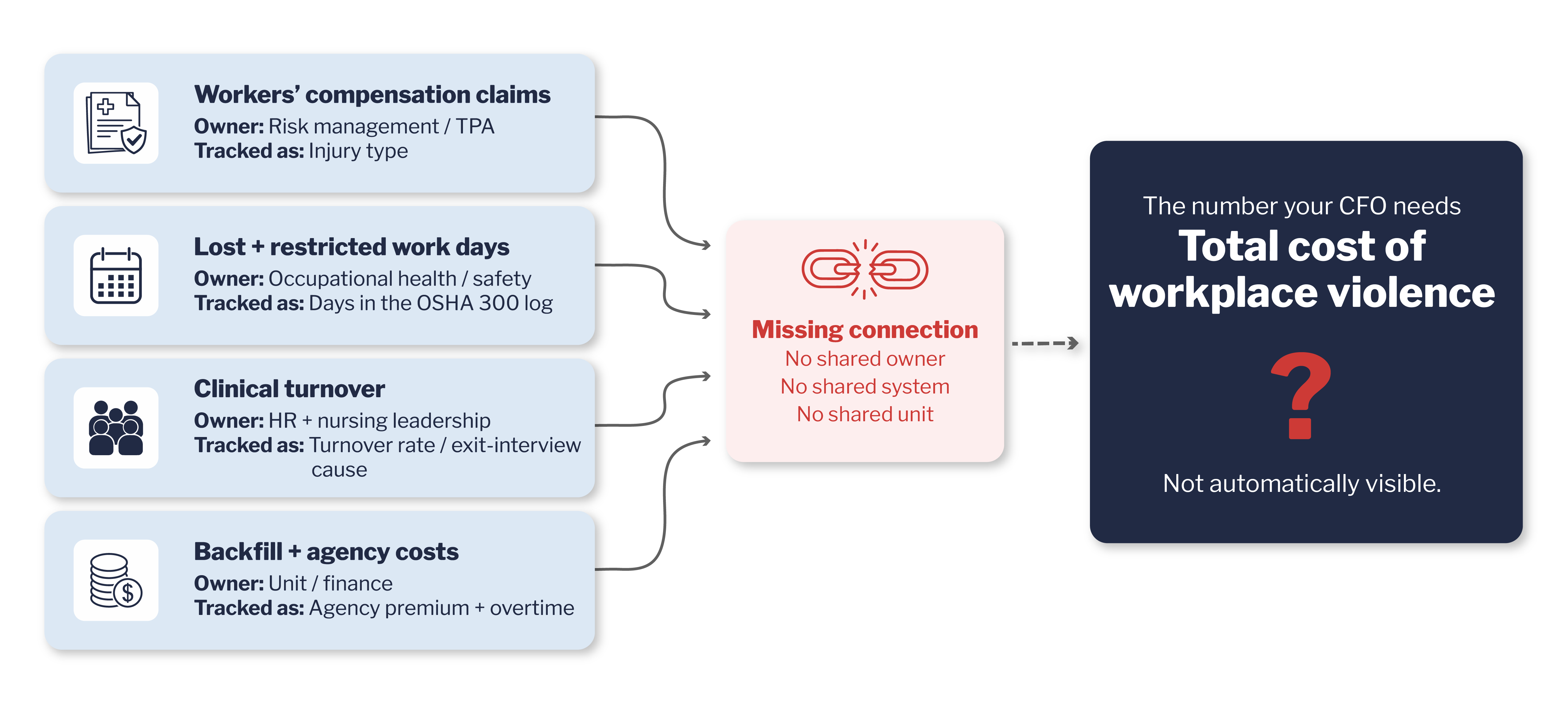
Our article on the cost of workplace violence in healthcare showed that the real cost of workplace violence sits in four systems, each with a different owner: workers' compensation claims with risk management, the OSHA 300 log with occupational health, backfill and premium pay with the staffing budget, and clinical turnover with HR and nursing leadership. Nobody owns the sum of all four, which is exactly why almost no hospital has a real number for what violence costs it.
Turnover is the exception, and it's worth being precise about why. A workers' compensation claim sits in a system a CFO rarely opens. The OSHA 300 log gets pulled out once a year, usually when a surveyor asks for it. Nurse turnover, by contrast, is reported monthly, sometimes weekly, tied to a vacancy rate the board already tracks, and in a growing number of systems it's linked directly to nursing leadership's own performance targets. It was already on the agenda before anyone mentioned workplace violence.
That explains something that puzzles a lot of people building this business case for the first time. Executives who will argue for an hour over whether a workers' compensation benchmark applies to their hospital will nod along instantly when you say violence drives turnover. They aren't being careless. They're pattern-matching against a number they already watch constantly, and the pattern feels obvious because the number is familiar. Familiarity isn't proof. It's just the reason this conversation is easier to start here than anywhere else in the cost model.
Why can't current research prove that workplace violence causes nurses to leave?
National Nurses United's newest survey, fielded from July 2025 through May 2026 across 1,267 registered nurses in 28 states and the District of Columbia, found that 25.5% of respondents had considered leaving the nursing profession because of workplace violence, and 18.6% had taken time off work following an incident. That is a considered-leaving figure, gathered close to the point of exposure, and it's the most current national data point available on the question.
It is worth distinguishing that figure from the 19.2% figure cited in our cost model, from National Nurses United's earlier 2024 survey. The older figure reports the share of nurses who have changed or left a job due to workplace violence, across a self-selected sample. A nurse changes jobs several times over a career, so the two numbers are measuring different things and shouldn't be added together or treated as the same claim measured twice. Both are directionally consistent. Neither is a share of any single year's separations.
A smaller study adds texture, with real limits attached. Researchers surveyed 132 emergency department nurses across public hospitals in Cyprus and found that those who reported decreased work motivation after a violent episode were dramatically more likely to consider leaving the profession entirely, with a wide confidence interval that reflects how small and specific the sample was. One country, one specialty, 132 nurses. The direction of the finding matches every larger study in this category. The magnitude shouldn't be quoted as a rate that applies to your hospital.
Here is the honest limit underneath all of it, and it's the same one the cost model in our business case article flagged. Dozens of published studies link workplace violence exposure to a nurse's stated intent to leave. Not one has followed violence-exposed clinicians into actual employment records to confirm the exposure caused an observed departure, as opposed to a departure that would have happened anyway, for reasons a nurse can't or won't fully separate from the ones they name in an exit interview. Intent and departure correlate in survey after survey. Nobody has proven the causal chain end to end, and a business case built as if someone already has is one hard question away from trouble.
What is one retained nurse worth?
None of that means the connection isn't worth acting on. It means the number you build should rest on what's actually published, not on stretching a survey finding past what it measured. Here's a number that clears that bar.
NSI Nursing Solutions' 2026 report puts the fully loaded replacement cost of a staff registered nurse (RN) at $60,090, covering advertising, recruiting, onboarding, orientation, and the productivity ramp of a new hire. That cost lands the moment a nurse leaves, regardless of why. NSI also reports that the average RN vacancy takes 78 days to fill, and that a travel RN runs $31.77 an hour above an employed staff RN including benefits. Applied to the average 78-day vacancy window rather than a full year, that premium adds roughly $14,100 in backfill cost before the seat is filled.
Add the two together and one prevented separation, one nurse who would have left over a safety concern and didn't, is worth approximately $74,200. That's the replacement cost your organization avoids plus the backfill premium it doesn't have to pay while the seat sits open. The floor is $60,090, if the unit absorbs the gap through internal reassignment or overtime rather than travel staff. The rare ceiling, if a position runs vacant and travel-covered for a full year, is about $126,200. Neither of those extremes is the number to plan around. The middle figure, built from NSI's own published averages, is.
|
Violence-attributed separations prevented |
Value at ~$74,200 each |
|
1 |
$74,200 |
|
5 |
$371,000 |
|
10 |
$742,000 |
|
25 |
$1,855,000 |
Replacement cost ($60,090, NSI Nursing Solutions 2026) plus backfill premium prorated to NSI's published average 78-day time to fill ($31.77 an hour travel premium, assuming 40 hours a week). Excludes injury and claims costs, which are a separate stream not tied to turnover, and unquantified costs to unit continuity and care quality.
That table doesn't require you to know what share of your turnover violence caused. It only requires knowing how many separations you actually prevented, which is a number your own data will eventually hand you if you make one change to how you collect it.
Why doesn't the retention number need an attribution guess?
The four-stream cost model in The Cost of Workplace Violence in Healthcare runs on three attribution scenarios (3%, 10%, and 20% of clinical separations) because nobody knows what share of turnover violence actually causes and the only published assumption is a deliberately conservative one from the American Hospital Association (AHA) and Harborview. That model has to guess, because it's answering the question of how big your total exposure is right now, before you've changed anything.
The retention-value number in this article answers a different question, and it's a question that doesn't require the guess. It isn't "How much does violence cost us today?" It's "What is each nurse we keep, instead of losing them, worth?" Once your program prevents even one separation that would otherwise have happened, and you can point to a coded exit interview or a documented near-miss to show why they stayed, the value of that outcome is no longer an estimate of attribution. You aren't estimating an unknown attribution rate anymore. You're counting something that already happened.
That's a meaningfully different position to argue a budget from. A model built on an attribution guess invites the obvious challenge: how do you know it was really violence. A model built on a retained nurse and a documented reason invites far less of that challenge, because the attribution is documented rather than estimated.
How can a hospital measure its own violence-related turnover?
Our business case article recommended adding a coded question to your exit interview, asking directly whether experiences of violence, aggression, or feeling unsafe contributed to a departing nurse's decision to leave, and tracking the answer instead of filing it as free text. That fix still stands, and it's the foundation for everything in this article. Without it, you have national survey percentages and no way to know your own.
Here's the piece to add specifically for retention. Build a second, simpler metric alongside your overall RN turnover rate: the separation rate among staff who reported a violence exposure or a safety concern through your incident-reporting system in the prior twelve months, measured against the separation rate among staff who didn't. You already have both halves of that comparison sitting in two systems that don't currently talk to each other: your incident log and your human resources information system (HRIS). Joining them for one cohort measure doesn't require a new survey, a new vendor, or a new attribution debate. It requires one join between two data sets you already keep.
If that cohort shows a materially higher separation rate than the rest of your workforce, you have a leading indicator you can act on months before it shows up in your aggregate turnover number, and you have it without waiting for anyone to publish the definitive study linking exposure to departure. If it doesn't, that's useful information too. Either way, it's a number your organization owns rather than one it borrowed from someone else's survey.
Where does training fit in nurse retention?
The Cyprus emergency department study cited earlier found something directly relevant to the Vistelar training model: nurses who hadn't attended communication skills training were over four times more likely to consider leaving the profession after a violent episode than nurses who had. That's one study, one country, a small sample, and a wide confidence interval, and it shouldn't be quoted as a national rate. It's directionally consistent with the larger intent-to-leave studies.
I've written elsewhere in this series about why de-escalation training fails when it's treated as a standalone curriculum rather than part of a comprehensive program. The same caution applies here. Training is not the retention fix by itself, and a vendor who tells you it is hasn't read the same literature this article just walked through. What the evidence supports is narrower and still useful: training appears to change how a nurse processes a violent episode afterward, which is part of why the 6 Cs of Conflict Management treats Closure, including debriefing and recovery, as a phase in its own right, not an afterthought to the incident itself. A program that trains people to prevent escalation and also trains them to recover from it when prevention fails is addressing retention from both directions. A program that only does the first is leaving the second half of the connection on the table.
The bottom line
Every executive in the room already believes workplace violence is a retention problem, and the newest national data, 25.5% of surveyed nurses considering leaving the profession over it, gives that belief real weight. What the evidence doesn't yet support is treating that belief as a proven causal chain from exposure to departure. It supports something narrower and still valuable: nurses who experience violence say it changes their intent to stay, one small study suggests training may blunt that effect, and each nurse your program actually keeps is worth roughly $74,200 in avoided replacement and backfill cost, a figure that doesn't require you to guess at attribution the way the aggregate cost model does.
Use the number that doesn't need the guess. Build the metric that proves the rest over time.
Want help building a violence-exposure retention metric from your own exit interview and incident data? Schedule a conversation with our team.
Frequently Asked Questions
Have a question? We are here to help.
The evidence links violence exposure to a nurse's stated intent to leave in dozens of published studies. No published study has followed violence-exposed nurses into actual employment records to confirm the exposure caused an observed departure, as opposed to correlating with one. The connection is well supported at the level of intent and not yet proven at the level of observed cause and effect.
National Nurses United's 2025 to 2026 survey of 1,267 registered nurses across 28 states and the District of Columbia found that 25.5% had considered leaving the nursing profession because of workplace violence, and 18.6% had taken time off work after an incident.
Approximately $74,200 per prevented separation, combining NSI Nursing Solutions' published $60,090 replacement cost with roughly $14,100 in backfill premium prorated to NSI's average 78-day time to fill. The floor, with no travel backfill, is $60,090. This figure excludes injury and claims costs and any unquantified impact on unit continuity and care quality.
No. The aggregate cost model needs an attribution assumption because it's estimating total exposure before anything has changed. The retention-value figure only requires knowing how many separations your program actually prevented, which a coded exit interview can tell you directly, without estimating a national attribution rate.
One small study of emergency department nurses in Cyprus found that those without communication skills training were over four times more likely to consider leaving the profession after a violent episode than those with it, though the sample was small and the confidence interval wide. Training appears to be a protective factor within a comprehensive program. Published evidence does not support training alone, delivered as a standalone curriculum, as a fix for turnover or for workplace violence generally.
Both come from National Nurses United surveys but measure different things. The 19.2% figure, from the 2024 survey, reports the share of nurses who have changed or left a job due to workplace violence. The 25.5% figure, from the newer 2025 to 2026 survey, asks whether a nurse has considered leaving the nursing profession because of workplace violence. They shouldn't be added together or treated as the same claim measured twice.
Sources
El Riz, A. T., Dimitriadou, M., & Karanikola, M. (2025). Workplace violence, self-perceived resilience and associations with turnover intention among emergency department nurses: A cross-sectional study. Healthcare, 13(20), 2562. https://doi.org/10.3390/healthcare13202562
National Nurses United. (2024, February). High and rising rates of workplace violence and employer failure to implement effective prevention strategies is contributing to the staffing crisis [Report]. https://www.nationalnursesunited.org/high-and-rising-rates-of-workplace-violence-and-employer-failure-to-implement-effective-prevention
National Nurses United. (2026, May). The state of workplace violence in health care in 2025-26: Nurses report increasing workplace violence rates, failure of employers to implement proven prevention measures [Brief]. https://nationalnursesunited.org/the-state-of-workplace-violence-in-health-care-in-2025-2026
NSI Nursing Solutions, Inc. (2026). 2026 NSI national health care retention & RN staffing report. https://www.nsinursingsolutions.com/documents/library/nsi_national_health_care_retention_report.pdf
University of Washington Harborview Injury Prevention and Research Center. (2025). The burden of violence to US hospitals. American Hospital Association. https://www.aha.org/press-releases/2025-06-02-new-aha-report-finds-workplace-and-community-violence-cost-hospitals-more-18-billion-annually
More from Vistelar
- What Workplace Violence Actually Costs a Hospital: A Line-Item Breakdown
- The Cost of Workplace Violence in Healthcare: Building the Business Case for Culture Change
- Why De-Escalation Training Fails (And How to Fix It)
- Incident Reporting Isn't Enough: What Your Team Isn't Telling You
- How to Budget for Conflict Prevention (And Why You Can't Afford Not To)