Building a Workplace Violence Reporting Culture Where Staff Actually Report
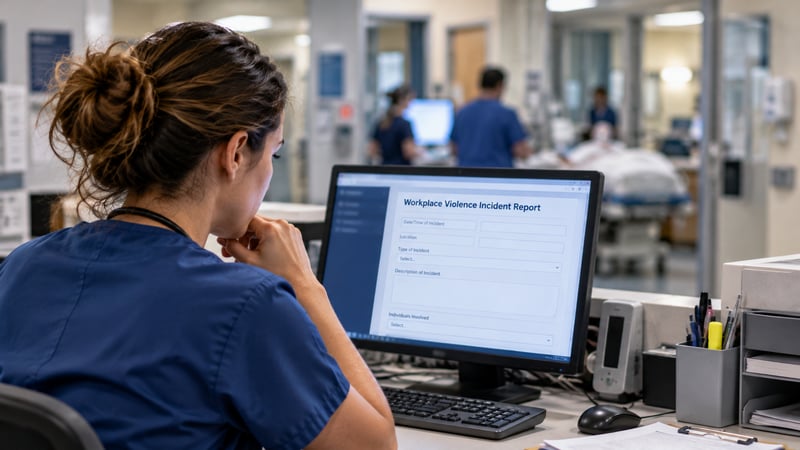
Make the form easier and reporting barely moves. Here is what the data says actually changes it, and what to do with the reports once they start coming in.
Most workplace violence programs treat underreporting, the most visible sign of a weak reporting culture, as a design problem. Simplify the form, add a mobile option, let people report anonymously, and the thinking goes that reporting will rise and the organization will finally see its real numbers. Some of that is worth doing. None of it is the reason staff aren't reporting.
I design workplace violence strategy for a living. I built and ran healthcare security and workplace violence strategy for Ascension, the fifth-largest health system in the United States, reaching every market where that system operates, and I work the same problem now as chief operating officer at Vistelar. Before any of that, I started my healthcare journey on night shifts in one of the busiest emergency departments in Birmingham, and I filled out my share of incident reports that never seemed to go anywhere. This article is organizational, not individual. It isn't about how one nurse should fill out one form. It's about what a hospital has to build, as a system, before that form means anything.
What is a workplace violence reporting culture?
A workplace violence reporting culture is not a form. It has four parts:
-
A definition everyone shares
-
A channel that's actually easy to reach
-
A response that closes the loop back to the person who filed it
-
A way of using what comes in that goes further than reporting it out
Miss any one of those four and the other three don't save you. Most programs get the channel right and stop there.
KEY TAKEAWAYS
-
Reporting variation across hospitals mostly reflects definitions, not violence. A 2022 study of 413 California hospitals found reported incidents ranging from zero to six per staffed bed from July 2017 to June 2020, driven largely by whether a hospital's procedure counted anything short of physical harm as reportable at all.
-
Fixing the channel without fixing the response can make things worse, not better. A 2023 study in the Journal of Nursing Care Quality found that a strong reporting culture was associated with a stronger relationship between violence and burnout, not a weaker one. Asking people to report into a system that doesn't respond teaches them something about the organization.
-
The top reason nurses gave for not reporting was the belief that nothing would change. In a 2026 Nurse.org survey of 2,090 nurses, 46% of those who'd experienced an incident didn't report it formally. Of those who did, 40% saw no action taken and only 9% felt supported by leadership.
-
Shared definitions are a reporting-culture tool, not a paperwork exercise. Both Vistelar's own framework and the published research show that when staff and leadership don't agree on what counts, people quietly stop reporting things they've decided don't rise to the level of "real" violence.
-
Aggregated data has to be used, not just reported out. A dashboard that shows the same rolled-up number to the same committee every quarter isn't a reporting culture. Reporting culture is what happens when that data gets pointed at specific units, specific shifts, and specific dollars, and something visibly moves in response.
Why doesn't a simpler form increase workplace violence reporting?
A simpler form does not fix underreporting, because the biggest differences in reporting come from definitions and procedures, not the form.
A 2022 mixed-methods study analyzed three years of California's mandatory workplace violence incident data across 413 hospitals and found reported incidents ranging from zero to six per staffed bed. Sixteen hospitals, about 4% of the sample, reported two or more incidents per staffed bed. The rest reported far fewer. That is not a plausible range of actual violence exposure across similar facilities. It's a range of reporting practice.
The researchers found the mechanism behind it, and it has nothing to do with how easy the form is to fill out. Some hospitals have workers file their own electronic reports. Others route documentation through a manager or security officer instead, which adds a person between the event and the record. And some hospitals, in the researchers' words, appear to report only incidents that involved physical harm to the worker, which means a verbal threat, a thrown object that missed, or a patient grabbing at a badge and letting go never enters the system at all.
A 2022 systematic review of the barriers nurses report pulls in the same direction. It identifies five barriers:
-
Fear of negative consequences, the most common barrier by a wide margin
-
Inadequate reporting infrastructure
-
A lack of cooperation across departments
-
Insufficient training in what and how to report
-
A blame culture that punishes the person who speaks up instead of fixing what let the incident happen
None of those five barriers is "the form takes too long," and simplifying a form does nothing to any of them.
If your hospital's incident count looks better than a peer's, that's worth checking before it's worth celebrating. It may mean you're safer. It may mean you count differently.
What happens when staff report and nothing changes?
When reports go unanswered, staff stop expecting action. A 2023 study by Kim and colleagues found that a strong violence-reporting culture was associated with a stronger relationship between violence and staff burnout, not a weaker one.
"Reporting rates are not just a measure of how much violence occurs. They are a measure of what staff have learned to expect from reporting it."
Casey Goldschmidt, CEM
A 2026 Nurse.org survey of 2,090 nurses puts numbers on exactly that expectation. Of the 1,204 respondents who'd experienced a workplace violence incident, 54% reported it through a formal channel and 46% did not. The leading reason given for not reporting wasn't the form, the time, or even fear of retaliation. It was that the nurse didn't believe anything would change. And of the majority who did report, 40% saw no action taken as a result, and only 9% felt supported by leadership afterward.
The Kim study and the Nurse.org survey together suggest a likely sequence. An organization builds an easier reporting channel. Reporting rises, briefly, because people who were on the fence now have a lower-friction way to try it. Nothing visible happens in response to most of what comes in. Staff update their expectation of what reporting is for, and reporting falls back toward wherever it started, except now more people have personally tested the system and confirmed it doesn't work. That's a worse position than the one you started in, because you've spent the credibility a new system usually gets on its first impression.
A reporting campaign, launched by itself, is not a neutral move. It's a promise, and an organization that can't keep it would often be better off not making it yet.
What does a workplace violence reporting culture need?
A reporting culture needs three things before a reporting campaign: shared definitions, reachable channels, and communication pathways that close the loop. The channel, which is the part almost every program addresses first, is the smallest of them.
Shared definitions. Vistelar's own training defines four types of workplace violence: criminal intent, client-on-worker, worker-on-worker, and violence stemming from a personal relationship outside of work. If your organization's leadership, your frontline staff, and your incident-reporting form don't share that same map, you get the pattern the 2022 California study found: some people report a verbal threat and some people decide it doesn't count, in the same building, in the same week. Worker-on-worker violence, in particular, is often quietly excluded from what people consider "reportable," because it doesn't fit the mental picture of a patient or visitor incident.
A shared definition also has to reach into how a report is written, not just what triggers one. Vistelar's own reporting guidance draws a hard line between subjective and objective language: "The individual became aggressive and hostile" is a conclusion one person drew. "The individual raised their voice and stepped closer" is what happened, and two different observers would write it the same way. An organization that trains everyone to report the second way instead of the first makes its data usable, because conclusions can't be aggregated across a hospital and behaviors can.
Reachable channels. I've written in detail about the mechanics of channel design in Incident Reporting Isn't Enough: What Your Team Isn't Telling You. They include, among others:
-
Tiered severity categories
-
Mobile access
-
A near-miss pathway
-
An anonymous option
That piece is worth reading if you haven't fixed the channel yet. This article assumes you'll get that part right, because it isn't the part that's failing most programs. Build it well, then move on to the two parts that actually determine whether anyone uses it twice.
Communication pathways that close the loop. This is the piece the survey data says is missing. Every report should get two responses:
-
An acknowledgment. The person who filed the report hears back within a stated window: not a form-submitted confirmation, but a person saying it was received and what happens next.
-
A follow-up. Once a disposition is reached, the reporter hears what it was, even if the disposition is that no further action was warranted, and why.
Vistelar's own debriefing framework already asks the right question after every incident: what steps can be taken to prevent a similar incident, and are there specific actions, tools, or policy changes that could mitigate the risk. Answer that question and tell the reporter the answer. That second half is the step almost everyone skips, and it is likely part of why only 9% of nurses in the 2026 Nurse.org survey felt supported by leadership.
How should hospitals use workplace violence incident data?
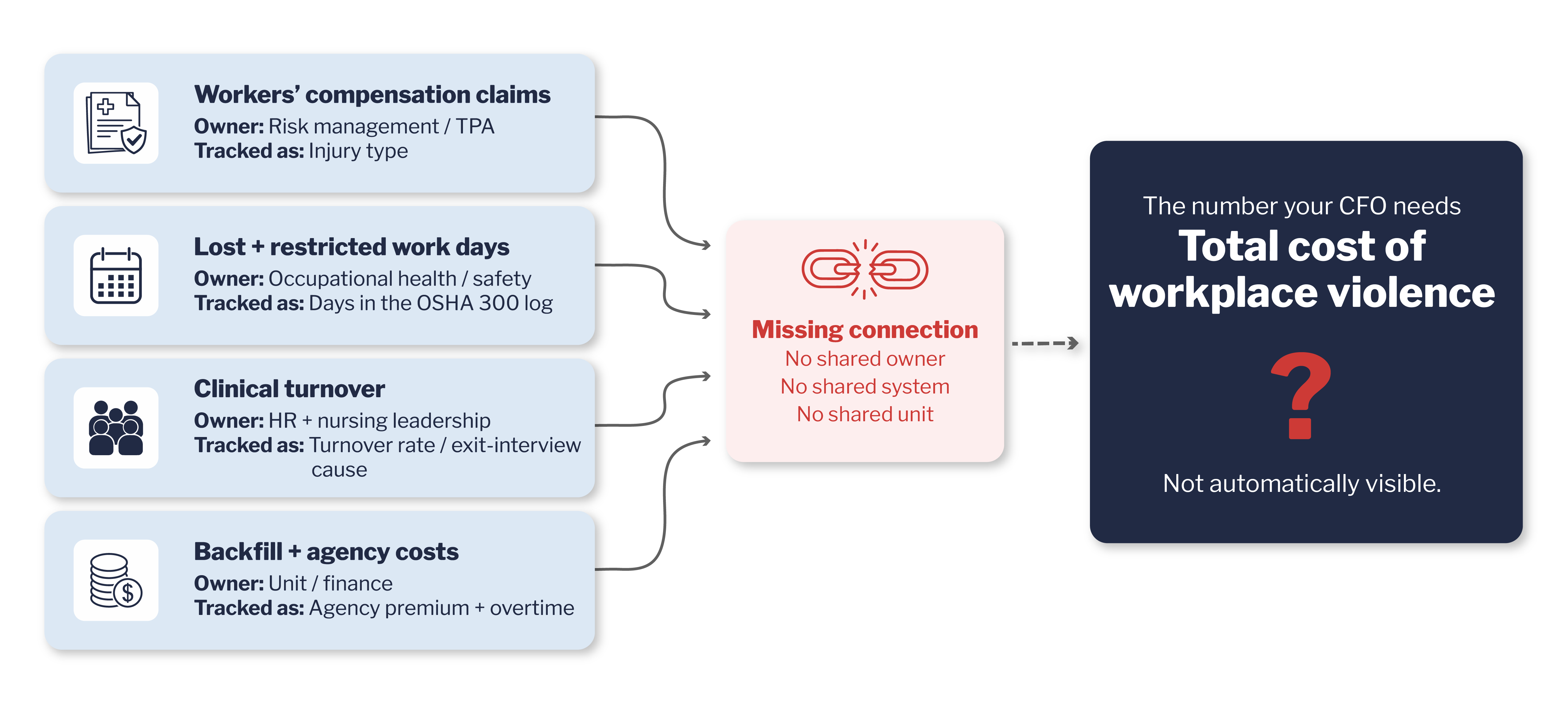
Hospitals should combine incident rates, cost, and turnover in one view and review it against each unit's own baseline.
Closing the loop with individual reporters fixes the relationship between one person and one report. It doesn't do anything with the aggregate, and the aggregate is where the financial case and the human cost both live. Most programs stop at a quarterly rollup: total incidents, maybe a chart, presented to a safety committee and then filed. That's reporting the data out, not using it.
Using the data means building one view that does three things a routine incident count doesn't:
-
Normalizes by exposure, so a busy unit doesn't look artificially dangerous
-
Translates the count into what it's actually costing, using the methods laid out in What Workplace Violence Actually Costs a Hospital
-
Sits it next to a human-cost signal like the turnover rate among staff who've reported an exposure, so a unit's problem doesn't get filed away as a safety metric when it's already showing up as a staffing one
|
Dashboard element |
Where the data already lives |
What it actually tells you |
|
Incidents per occupied bed or per full-time equivalent, not raw count |
Incident log joined to census or staffing data |
Whether a unit is actually higher-risk or just higher-volume |
|
Estimated dollar exposure at your attribution assumption |
Turnover, claims, and backfill data, per the line-item method |
Which units are actually driving the cost your board is asking about |
|
Violence-exposed staff turnover rate vs. the rest of the unit |
Human resources information systems joined to the incident log by employee |
The human cost a safety-only report never shows |
|
Trend against that same unit's prior four quarters |
The same systems, tracked over time |
Whether a spike is a signal worth acting on or normal variation |
A framework for what to track, not a filled-in example. Every row uses data most hospitals already collect in two or three separate systems; the work is joining them.
Once a unit's rate and dollar exposure are both visibly higher than its own baseline, that's your target for the next round of training refreshers, staffing adjustment, or environmental change, not a hospital-wide rollout applied evenly regardless of where the risk actually sits. And once you've acted, the same view tells you whether it worked, because the trend-against-baseline row doesn't go away after the intervention. It's the sustaining half of the exercise.
"A dashboard nobody acts on is just a more expensive way to ignore the same problem."
Casey Goldschmidt, CEM
Building this view does not require new software or a new survey. It requires deciding that the incident log, the human resources system, and the cost model are three views of one problem, and reviewing them together on a standing cadence rather than as three separate reports that never meet.
The bottom line
A reporting culture isn't a form, and it isn't a campaign. It's a shared definition of what counts, a channel that's easy to reach, a communication pathway that closes the loop back to every person who spoke up, and a standing habit of turning the aggregate into a target rather than a slide. Build the first three and skip the fourth, and you'll have more reports and the same blind spots. Build all four, and the data starts doing the job it was supposed to do from the beginning: telling you where to act, and telling you what it's worth.
Fix the loop before you fix the form. The form was never what was stopping them.
Frequently Asked Questions
The most common reason, by a wide margin in a 2022 systematic review by Hamed and Konstantinidis, is fear of negative consequences, followed by inadequate reporting infrastructure, lack of cooperation across departments, insufficient training, and a blame culture. In a 2026 Nurse.org survey of 2,090 nurses, the single leading reason given was simpler still: the nurse didn't believe anything would change as a result. For more on reporting channels, see Incident Reporting Isn't Enough: What Your Team Isn't Telling You.
It may increase reporting briefly, but published research doesn't support it as a lasting fix. A 2023 study by Kim and colleagues in the Journal of Nursing Care Quality found that a strong reporting culture was associated with a stronger relationship between violence and burnout, not a weaker one, and one possible explanation is that reporting into a system that doesn't visibly respond makes the underlying problem worse rather than better.
A reportable incident should cover all four recognized types of workplace violence, defined organization-wide before anyone builds a form. Workplace violence breaks into four recognized types: criminal intent, client-on-worker, worker-on-worker, and violence from a personal relationship outside of work. A 2022 study of 413 California hospitals by Odes and colleagues found reported incidents ranging from zero to six per staffed bed, driven largely by whether a hospital's procedure counted anything short of physical harm as reportable at all.
There are signs that pushing staff to report more without fixing anything else can backfire. In a 2026 Nurse.org survey, 40% of nurses who reported an incident saw no action taken, and only 9% felt supported by leadership afterward. Asking people to report into a system that doesn't respond teaches them what to expect from it, and that expectation is what determines future reporting, not the design of the form.
Build one view that normalizes incidents by occupied beds or full-time equivalents rather than raw counts, translates the count into estimated dollar exposure using a line-item cost method, and adds a human-cost signal such as turnover among staff who've reported an exposure. Used together and tracked against each unit's own baseline over time, that view identifies where to target an intervention and whether it worked, which a quarterly incident count alone cannot do. The cost method is described in What Workplace Violence Actually Costs a Hospital.
Compare the unit's rate, not its raw count, against its own trailing baseline rather than against other units, since higher patient volume alone produces more incidents without indicating higher risk. A sustained move above that unit's own prior four quarters is a signal worth investigating. A single elevated month, in isolation, usually is not.
Sources
-
Hamed, M. M. M., & Konstantinidis, S. (2022). Barriers to incident reporting among nurses: A qualitative systematic review. Western Journal of Nursing Research, 44(5), 506–523. https://doi.org/10.1177/0193945921999449
-
Kim, S., Lynn, M. R., Baernholdt, M. B., Kitzmiller, R., & Jones, C. B. (2023). How does workplace violence-reporting culture affect workplace violence, nurse burnout, and patient safety? Journal of Nursing Care Quality, 38(1), 11–18. https://doi.org/10.1097/NCQ.0000000000000641
-
Odes, R., Chapman, S., Ackerman, S., Harrison, R., & Hong, O. (2022). Differences in hospitals' workplace violence incident reporting practices: A mixed methods study. Policy, Politics, & Nursing Practice, 23(2), 98–108. https://doi.org/10.1177/15271544221088248
-
Walker, A., & Wiley, J. (2026, April 7). 27% of nurses were physically assaulted in 2025; most didn't report it (Nurse.org survey). Nurse.org. https://nurse.org/articles/nurses-workplace-violence-2026
Want help designing a reporting culture that closes the loop and connects to your cost model? Schedule a conversation with our team.
More from Vistelar
This blog covers topics that include: Incident Reporting and Underreporting · Safety Culture