Workplace Violence Training Documentation: What Surveyors Look For
A completion rate proves people clicked through a module. Here is what the Joint Commission, CMS, OSHA, and state law each ask your training records to prove, and how to build a file that shows capability instead of attendance.
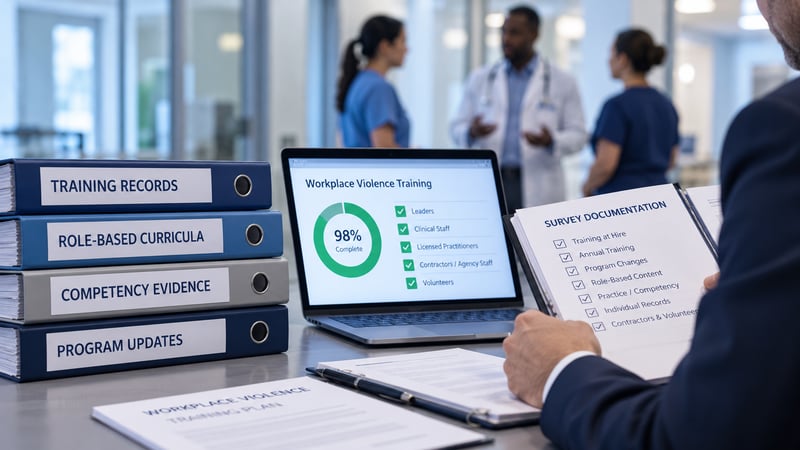
A training dashboard that reads 98% complete tells a surveyor almost nothing about whether your staff can do what the Joint Commission asked you to teach them. It tells them a module was assigned and a box was checked. The surveyor already knows that, which is why the next move is to walk onto a unit and ask a nurse what they would do.
The Joint Commission's workplace violence standard, renumbered NPG.02.04.01 in January 2026, spells out who must be trained, when, and on what. CMS has its own clock and proof standard, OSHA reads training records as evidence of what was feasible, and a growing list of states adds timing rules and competency testing. Four regulators read the same file for four different reasons.
In our article Workplace Violence Compliance in Healthcare: Joint Commission, CMS, OSHA, and State Requirements, I made the case that every regulator makes you write down what you know about violence risk, and that the file is both the compliance record and the exhibit. Training documentation is the part of that file most organizations believe is finished. In most of the systems I have audited, it is the part with the widest gap between what the report says and what the units can do.
Compliance is the floor here, and it is worth meeting precisely. But the record that satisfies a surveyor and the record that proves your people are ready can be the same record, if you build it that way on purpose. So build the file to document capability, not attendance.
KEY TAKEAWAYS
-
NPG.02.04.01 EP 2 requires role-based training at hire, annually, and whenever the program changes, for leaders, staff, and licensed practitioners, across four named content areas.
-
Surveyors test the file on the unit: through tracers, brief staff interviews, and by matching what a person was taught to the role they actually work.
-
CMS adds contractors, people providing services under arrangement, and volunteers, with documentation and demonstrated staff knowledge. OSHA reads the same records as evidence of feasible abatement.
-
A roster proves attendance. Practice logs, role-to-tier mapping, and refreshers tied to your worksite analysis prove capability.
What does the Joint Commission require for workplace violence training documentation?
Workplace violence training documentation is the dated, individual record that proves each person who works in your hospital received training matched to their role, in the four content areas NPG.02.04.01, element of performance (EP) 2, names, at hire, annually, and whenever the program changes. Everything a surveyor asks for under EP 2 tests one part of that sentence.
Timing comes first. EP 2 requires training, education, and resources at time of hire, annually, and whenever changes occur to the program. The third rarely has a record behind it.
Audience comes next. EP 2 names leaders, staff, and licensed practitioners, with content determined by role. Licensed practitioners are where systems quietly fall short, because many physicians and advanced practice providers are credentialed through the medical staff office rather than onboarded through HR, and their training never touches the system that produces the completion report.
Then content. EP 2 specifies four areas: what constitutes workplace violence; the roles and responsibilities of leaders, clinical staff, security personnel, and external law enforcement; training in de-escalation, nonphysical intervention skills, physical intervention techniques, and response to emergency incidents; and the reporting process. De-escalation, nonphysical intervention, and physical intervention are named as distinct items. A single annual module does not cover them.
One housekeeping note. The training requirement used to sit at HR.01.05.03 EP 29. When the Joint Commission reorganized hospital requirements into National Performance Goals in January 2026, that obligation moved to NPG.02.04.01 EP 2, and the old citation no longer applies to hospitals. If your hospital's training policy still cites HR.01.05.03, update it.
How surveyors test training records on the unit
Surveyors test training by comparing what the file says against what staff can tell them, so the record has to survive a conversation. The Joint Commission describes its tracer methodology as a combination of interview, document review, and observation, and staff interviews as brief, built on a few well-phrased questions, with open-ended questions preferred. The survey also includes a competence assessment session that reviews your competence assessment process and selected personnel files.
In practice, workplace violence training gets tested four ways, and none of them is reading your dashboard. The first is the tracer: a surveyor following a patient through the ED or behavioral health will meet staff along the way, and any of them can get a training question. The second is the interview, and the common version is simple: What would you do if this patient's family member started shouting at you? A nurse who names a first move, a way to get help, and how they would report it has just validated your file. A nurse who answers "call security" has told the surveyor the training never reached the bedside in usable form.
The third is matching content to role. If the ED nurse, the registration clerk, and the environmental services worker all completed the same 40-minute module, the gap is visible without opening a curriculum. The fourth is roster versus competency. A sign-in sheet shows who was in the room, not who can perform the skill, and for physical intervention that difference matters clinically and legally.
When I sit with a CNO and a COO before a survey, I do not ask for the completion rate. I ask what three people on the highest-risk unit would say if a surveyor stopped them tonight. That answer is the real state of your documentation.
What CMS adds: a second clock and a higher proof standard
CMS can reach workplace violence training through the emergency preparedness Condition of Participation, and its standard is stricter on proof than on frequency. Under 42 CFR §482.15(d)(1), hospitals must provide initial training to new and existing staff, individuals providing services under arrangement, and volunteers, then training at least every two years, with documentation and demonstrated staff knowledge.
That language does three things to your file. It pulls agency, travel, and contracted staff inside the requirement. It requires documentation at the individual level. And it asks for demonstrated knowledge, which a completion record does not prove. QSO-23-04-Hospitals (November 28, 2022) says CMS expects training at orientation and whenever policies change, and recommends ongoing training at least every two years; the binding two-year cycle and the update trigger are in the regulation, not the memo. The Joint Commission's annual cycle is stricter, so EP 2 timing satisfies CMS frequency. It does not automatically satisfy the CMS audience or proof standard.
What OSHA looks for: training records as evidence of feasible abatement
OSHA has no healthcare workplace violence standard, so it reads training records through the General Duty Clause, as evidence of what you recognized and what was feasible. OSHA 3148-06R (2016) names Safety and Health Training as the fourth of its five components and Recordkeeping and Program Evaluation as the fifth. It is voluntary guidance. OSHA enforces through the General Duty Clause, where guidance like this can serve as evidence that a hazard was recognized and abatement was feasible.
That cuts both ways. A dated, role-based training record on a high-risk unit shows a recognized hazard met with a control. A thin record next to an OSHA 300 log full of assault entries shows a recognized hazard without one. In Cedar Springs Hospital, Inc. v. OSHRC (10th Cir. 2026), the court held that accreditation and CMS compliance do not displace OSHA, and found abatement feasible partly from what the hospital did after it was cited. By the same logic, training delivered after an incident could be used to show it was feasible before. Keep the date each high-risk unit's training gap closed.
What state laws add to the training file
State prevention-plan laws add their own triggers and content, and EP 3's note asks the worksite analysis to examine whether training and education conform to applicable laws and regulations.
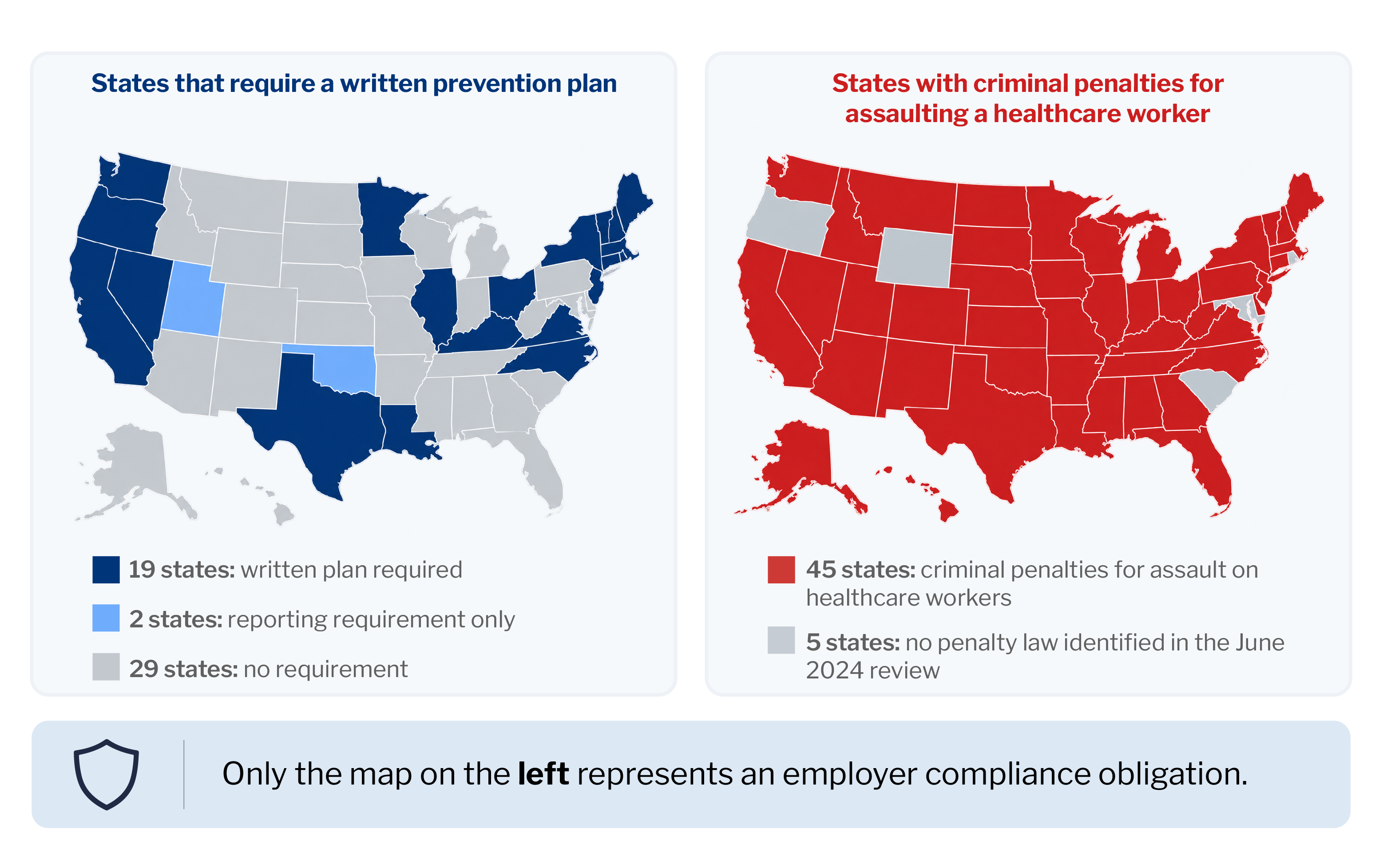
Our compliance article lists 19 states that require a written plan, and the training rules get specific. Kentucky requires training within 90 days of hire and annually, with competency testing. Minnesota requires training at orientation and before the first independent shift. Nevada requires training on hire, annually, and on reassignment to a new location, among other triggers. Rhode Island requires training within 90 days of hire and ongoing training across 12 specified topics. Virginia requires hospitals with an emergency department to adopt a security plan that sets training for security personnel in de-escalation, restraint and seclusion, crisis intervention, and trauma-informed approaches. California, Oregon, Louisiana, New Jersey, and Texas each require annual training in some form.
Three of those are documentation traps. "Before the first independent shift" and "on reassignment" depend on scheduling and transfer data your learning system never sees, and competency testing is a higher bar than completion.
The documentation crosswalk: requirement, request, and proof
Every training requirement maps to a specific request and a specific kind of proof, and building the file backward from that map is the fastest way to find gaps.
| Requirement | What the surveyor asks for | What good documentation looks like |
|---|---|---|
| EP 2 timing | Training at hire, annually, and after program changes | Individual dated records for each trigger, plus a change log linking each program change to a training assignment |
| EP 2 audiences | Leaders, staff, and licensed practitioners trained | Rosters reconciled against HR, the medical staff office, and agency vendors |
| EP 2 content by role | Role-differentiated curricula | A role-to-tier map by job code and unit, with the rationale |
| EP 2 four content areas | All four areas, with de-escalation, nonphysical, and physical intervention distinct | A content map tying each module and scenario to the area it covers |
| Tracers and interviews | Staff who can say what they would do and how they would report | Practice and scenario logs by unit |
| 42 CFR §482.15(d)(1) | Staff, services under arrangement, and volunteers, every two years, demonstrated knowledge | Contractor and volunteer records in the same system, plus skills checks |
| OSHA element 4 and General Duty Clause | Training records alongside 300 logs and hazard assessments | Dates showing when training reached each high-risk unit relative to identified hazards |
| State plan mandate | Whatever your state names, such as competency testing | A state addendum listing each rule, its trigger, and the field that proves it |
The row that fails most often is content by role. Most organizations can produce a completion report. Far fewer can produce the logic that decided who got what.
The six failures I see when auditing training records across a system
Across the health systems I have audited, the same six failures show up in almost every market.
-
Completion without content mapping: The report shows near-total completion, and nobody can show which EP 2 content areas the module covered.
-
One module for everyone: Low-risk areas spend nonproductive hours on skills they will not use, while the highest-risk units never get physical intervention training at all.
-
No physical intervention track separate from security: A security officer with enforcement duties and an ED nurse who may need to stabilize a patient do different jobs, and their training should not look the same.
-
Missing populations: Agency, travel, contracted, and float staff are absent because they are not in the HR system, and licensed practitioners because they are credentialed rather than hired. They often work the highest-risk shifts.
-
No training on program changes: The policy was revised or the reporting pathway moved, and nothing shows staff were trained on it.
-
No competency or practice evidence: The file proves people attended. Nothing proves they can do it.
These are ownership problems before they are content problems. Education owns the records, staffing owns the agency roster, the medical staff office owns credentialing, and whoever revised the policy owns the change. Four owners, no single view. Name one person who owns the whole file.
Build documentation that proves capability, not attendance
The file that holds up best is built to prove what staff can do, and it satisfies every regulator along the way. Here is the sequence I use.
Map every role to a tier on one framework
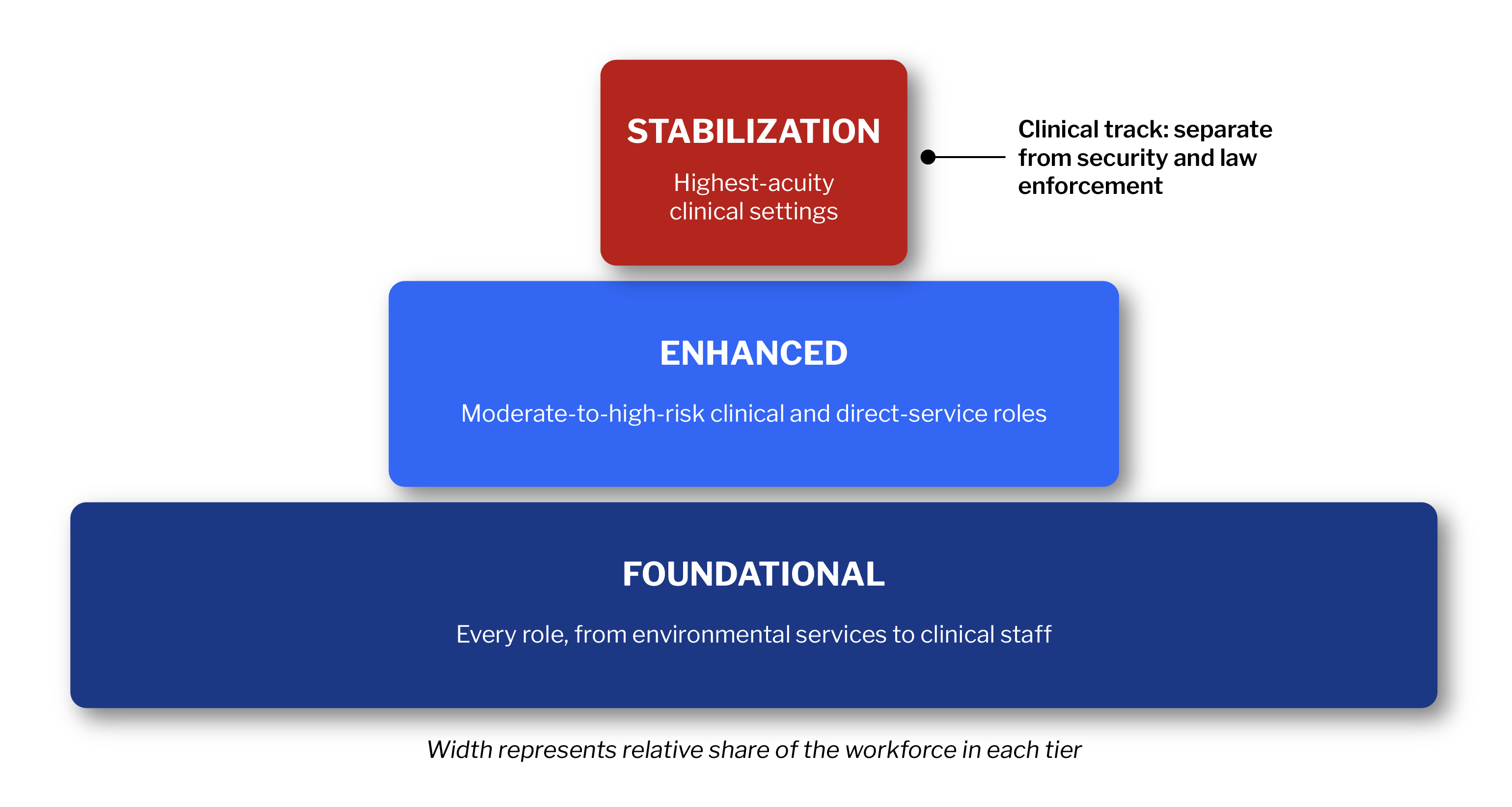
Start with risk, not the course catalog. In Vistelar training the shared framework is the 6 Cs of Conflict Management: Context, Contact, and Closure in every interaction, and Conflict, Crisis, and Critical when one escalates. The Foundational tier reaches every role with shared vocabulary, non-escalation, recognition of pre-violence behavior, and how to get help. The Enhanced tier adds de-escalation and team response for moderate- to high-risk clinical and direct-service roles, including registration. The Stabilization tier adds structured physical response for the ED, inpatient behavioral health, psychiatric emergency, and critical care, separate from the security track. Written down by job code and unit, that map is your answer to "content determined by role."
Document stabilization decisions, not only skills
The Vistelar Positive Interventions and Stabilization program is built for non-security professionals who may have to intervene physically, and it teaches staff to articulate the reasons for taking action. Its Justification | Desirability skill weighs training, policy, and threat level against position of advantage, backup, and likely outcome. A record showing staff practiced that reasoning is far more defensible than a roster. Physical intervention also sits inside CMS and Joint Commission restraint and seclusion requirements, so your policy and counsel govern the details.
Log practice, not just completion
Vistelar training treats the course as the first step toward proficiency; the manuals are direct that competent use on the job requires ongoing practice. The evaluation of our own program says the same. In a two-year independent evaluation at Milwaukee County Behavioral Health Division (MCBHD), conducted by researchers at the University of Wisconsin-Milwaukee, between 82% and 100% of direct-care respondents reported still using each skill two years after training, but the measured gain in conflict management skills faded. Keep a practice log by unit: huddle scenarios, post-incident debriefs, skills checks at the annual refresher. That log is your demonstrated knowledge.
Tie refreshers to the worksite analysis
When your EP 3 analysis shows incidents clustering in a new unit or time of day, schedule a targeted refresher there and record the link. Debrief notes help, because a structured debrief asks whether there were gaps in training, resources, or protocols.
Make program changes trigger training
Keep a dated change log for policies, reporting pathways, duress processes, and new state rules. Each entry should generate an assignment to the affected roles with a completion date.
Choose a model that stays current and tracks itself
A program built to evolve updates content when a standard changes, retargets when risk moves, and keeps practice going after launch. A curriculum taught through train-the-trainer and a binder is frozen the day it is delivered. That is why licensed models fit healthcare: content stays current, digital delivery reaches every role and shift with tracking built in, and a sustainment partner stays after launch. Vistelar moved from train-the-trainer to content licensing after that evaluation showed skill decay. The citations have changed twice in four years. Plan for the next change now.
"A roster tells the surveyor who was in the room. Your documentation should tell them who is ready."
Casey Goldschmidt, CEM
The bottom line
Workplace violence training documentation should prove three things: the right people got the right content for their role, they got it on every trigger the regulators name, and they can still use it. Build the file around capability, and it will answer every surveyor, inspector, and attorney who reads it.
Frequently Asked Questions
NPG.02.04.01 EP 2, effective January 2026, requires training, education, and resources at time of hire, annually, and whenever the program changes. It applies to leaders, staff, and licensed practitioners, with content determined by role. Training must cover what constitutes workplace violence; the roles of leaders, clinical staff, security, and law enforcement; de-escalation, nonphysical intervention, physical intervention, and emergency response; and the reporting process.
For Joint Commission-accredited hospitals, at hire, annually, and whenever the program changes. CMS requires initial training and then training at least every two years under 42 CFR §482.15(d)(1), so the Joint Commission cycle is stricter. Several states add their own rules, such as training within 90 days of hire in Kentucky and Rhode Island, or before the first independent shift in Minnesota.
Individual, dated records tied to specific content, not aggregate percentages. Evidence of training at hire, annually, and after program changes. Role-differentiated curricula covering all four EP 2 content areas. Records for leaders, staff, and licensed practitioners, plus contractors and volunteers for CMS. Surveyors also interview staff on the unit, so practice and competency evidence matters as much as the completion report.
Yes, and they are among the most commonly missing populations. CMS names individuals providing services under arrangement in 42 CFR §482.15(d)(1), and the Joint Commission requires training for staff working in your hospital. Agency and travel staff often work high-risk shifts, so reconcile their rosters against your training records. Licensed practitioners credentialed through the medical staff office need the same reconciliation.
Not on its own. A certificate proves attendance. CMS requires documentation and demonstrated staff knowledge, Kentucky requires competency testing, and surveyors test training by asking staff what they would do. Pair completion records with a role-to-tier map, a content map to the four EP 2 areas, and practice or scenario logs by unit that show staff rehearsed the skills they are expected to use.
Sources
Cedar Springs Hospital, Inc. v. Occupational Safety & Health Review Commission, No. 24-9519 (10th Cir. Feb. 13, 2026). https://www.ca10.uscourts.gov/sites/ca10/files/opinions/010111385425.pdf
Centers for Medicare & Medicaid Services. (2022). Workplace violence-hospitals (QSO-23-04-Hospitals). https://www.cms.gov/files/document/qso-23-04-hospitals.pdf
Condition of participation: Emergency preparedness, 42 C.F.R. § 482.15 (2026). https://www.ecfr.gov/current/title-42/chapter-IV/subchapter-G/part-482/subpart-B/section-482.15
Freiburger, T., & Romain Dagenhardt, D. (n.d.). An evaluation of the Vistelar Training Initiative at Milwaukee County Behavioral Health Division: Final survey report. Department of Criminal Justice and Criminology, University of Wisconsin–Milwaukee. https://www.vistelar.com/hubfs/Final%20Survey%20Report%20-%20MCBH-UWM-Research%20%281%29.pdf
The Joint Commission. (2025). National Performance Goals: Effective January 2026 for the hospital program. https://digitalassets.jointcommission.org/api/public/content/9ca80055182b4274842a5780a94f2c82
The Joint Commission. (2026). Hospital accreditation survey process guide (September 2026 ed.). https://digitalassets.jointcommission.org/api/public/content/042e91a71c554f8098e55a025508b029?v=4bdc7fcc
Occupational Safety and Health Administration. (2016). Guidelines for preventing workplace violence for healthcare and social service workers (OSHA 3148-06R). https://www.osha.gov/sites/default/files/publications/osha3148.pdf
Romain Dagenhardt, D. M., Heideman, A. J., Knoche, V. A., & Freiburger, T. L. (2022). An evaluation of a de-escalation conflict management training in a behavioral health hospital setting. International Journal of Conflict Management, 33(1), 84–110. https://doi.org/10.1108/IJCMA-03-2021-0039
If your training report shows a high completion rate and you are not sure what your highest-risk unit would say tonight, start there. We would welcome that conversation. Schedule a discovery call.
More from Vistelar
- Workplace Violence Prevention in Healthcare: Non-Escalation and De-Escalation
- The Joint Commission 2026 Mandatory WPV Change
- How Leading Hospitals Measure the Success of Their De-Escalation Programs
- Conflict Is a Systemic Issue: Here's How to Build a Systemic Solution
- Incident Reporting Isn't Enough: What Your Team Isn't Telling You
This article is general information about regulatory requirements and is not legal advice. Requirements change. Confirm anything you plan to rely on with your own counsel.
This blog covers topics that include: Training Documentation · Joint Commission · Survey Readiness · Compliance · Workplace Violence · CMS