Is the Federal Workplace Violence Prevention Act Going to Pass? What Healthcare Leaders Should Watch
Four federal bills, two very different ideas, and an industry that agrees on the problem but not the fix. Here is where each bill stands, what the major voices in healthcare are saying, and what would have to happen for any of it to become law.
Every workplace violence committee I sit in eventually gets the same question from someone at the table: is the federal bill going to pass? Usually it is asked with hope. Occasionally it is asked as a reason to wait. Both versions deserve a straight answer, because the honest one changes how a health system should spend the next 18 months.
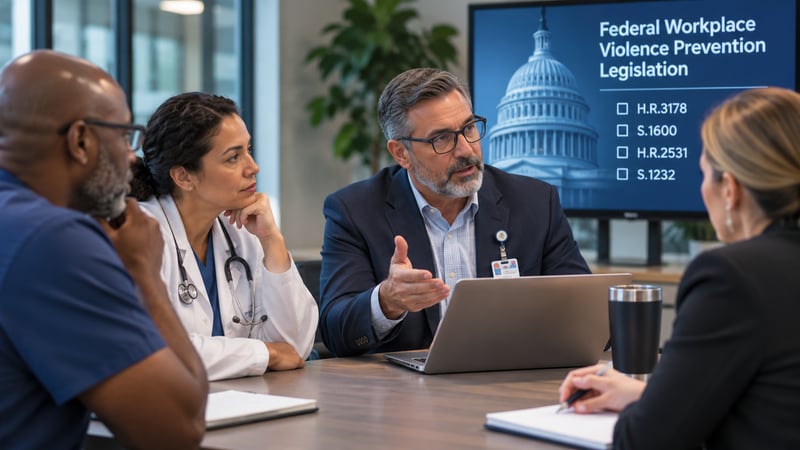
The first problem is that there is no single "federal bill." There are four bills in the 119th Congress, they come in two pairs, and they do entirely different things. One pair would make assaulting a healthcare worker a federal crime. The other pair would direct the Occupational Safety and Health Administration (OSHA) to issue an enforceable workplace violence standard for healthcare and social service employers. Internal memos merge them constantly, and the industry's major voices line up behind them very differently.
The second problem is that "pending" sounds like progress when it is not. As of this writing, all four bills sit where they landed in 2025: referred to committee, with no hearing, no markup, and no floor vote. Cosponsors keep signing on, which looks like momentum in a tracking report but does not move a bill out of committee.
This article goes deeper on the federal legislation section of our article Workplace Violence Compliance in Healthcare: Joint Commission, CMS, OSHA, and State Requirements. The short answer to the question in the title is no, not in this Congress. The more useful answer is what to watch, and why your program should not be waiting on any of it.
KEY TAKEAWAYS
-
Four bills are pending in the 119th Congress: the Save Healthcare Workers Act (H.R.3178 and S.1600) would make assaulting hospital personnel a federal crime; the Workplace Violence Prevention for Health Care and Social Service Workers Act (H.R.2531 and S.1232) would direct OSHA to issue a standard.
-
None has had a hearing, markup, or floor vote. Bills that do not pass by the end of the 119th Congress, in January 2027, die and must be reintroduced.
-
The industry agrees on the problem and splits on the fix: hospital associations back criminal penalties and have opposed an OSHA mandate; nursing unions and the American Nurses Association back the OSHA standard; the Emergency Nurses Association supports both bills, and the American College of Emergency Physicians has championed the Save Healthcare Workers Act.
-
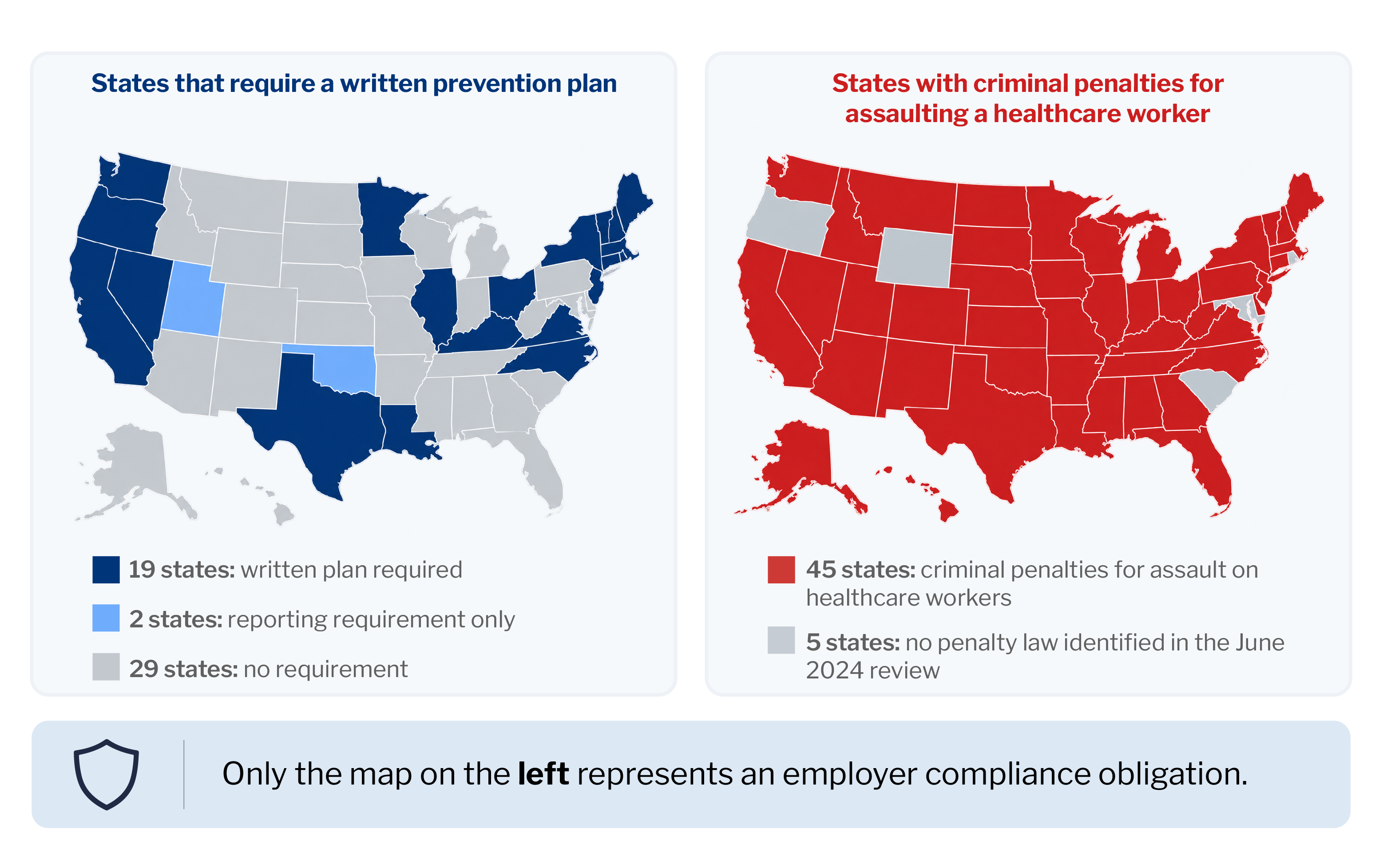
Build to what already binds you: the Joint Commission's NPG.02.04.01, the Centers for Medicare & Medicaid Services (CMS), the OSHA General Duty Clause, and 19 state plan laws.
Is the federal workplace violence prevention bill going to pass?
The federal workplace violence bills are unlikely to pass in the 119th Congress, because none has cleared a committee, and any bill not enacted before the Congress ends in January 2027 must start over in the next one. That reflects the calendar, not the bills' merit. A bill that has not had a hearing by the fall of the second session has a very short runway, and the most realistic path left for any of them is being attached to a larger, must-pass bill, which happens rarely and usually with little warning.
The longer history points the same way. The OSHA standard bill has passed the House twice. In November 2019, as H.R.1309, it passed 251 to 158. In April 2021, as H.R.1195, it passed 254 to 166, with 38 Republicans voting yes. Both times, the Senate never voted on it. The bill was reintroduced in the 118th Congress and again in April 2025 as H.R.2531 and S.1232. Two House passages and no Senate vote are the clearest signal of where this bill stands.
The criminal penalty bill has a different history and a different coalition. Its predecessor in the 118th Congress was the SAVE Act, the Safety from Violence for Healthcare Employees Act. The current version, the Save Healthcare Workers Act, was introduced in May 2025 with bipartisan sponsors in both chambers: Reps. Madeleine Dean and Mariannette Miller-Meeks in the House, and Sens. Cindy Hyde-Smith and Angus King in the Senate. Bipartisan sponsorship gives it a better structural profile than the OSHA bill. It has not translated into committee action.
Two pairs of bills that do very different things
The distinction matters because your obligations would change under one pair and not at all under the other.
| Bill | What it would do | What it would require of your organization |
| Save Healthcare Workers Act (H.R.3178, S.1600) | Make knowingly and intentionally assaulting or intimidating hospital personnel a federal crime, and fund voluntary hospital security grants | Nothing directly. It is a criminal statute aimed at perpetrators, not a compliance standard for employers |
| Workplace Violence Prevention for Health Care and Social Service Workers Act (H.R.2531, S.1232) | Direct the Department of Labor to issue an enforceable OSHA workplace violence standard for healthcare and social service employers | A written, worksite-specific prevention plan developed with frontline staff, hazard assessment, training, incident recordkeeping, and anti-retaliation protections, enforced by OSHA |
Two details from Workplace Violence Compliance in Healthcare are worth repeating because they show up wrong in board decks. First, it is the Save Healthcare Workers Act, not an acronym; SAVE was the prior version. Second, the OSHA bill's Medicare provision is narrower than it is usually described. It would condition Medicare participation on compliance only for hospitals and skilled nursing facilities not otherwise covered by the Occupational Safety and Health Act or an approved state plan, which is a gap-filler for public employers OSHA cannot reach, not a blanket Medicare condition.
What the industry is saying
The healthcare community is close to unanimous that workplace violence is a crisis. It is not unanimous on what Washington should do about it, and the split is predictable once you see who carries which bill.
Hospital associations: criminal penalties yes, an OSHA mandate no
The American Hospital Association (AHA) has been the most visible advocate for the Save Healthcare Workers Act. When it was introduced, AHA President and CEO Rick Pollack called it "unacceptable that these dedicated caregivers regularly face the threat of violence while working to help patients heal." The AHA's case rests on patient care as much as staff safety: "Providers cannot deliver attentive care when they are afraid for their personal safety, distracted by disruptive patients or family members, or traumatized from prior attacks."
On the OSHA standard bill, the AHA has been on the other side. In 2021 it told the House that "hospitals have already implemented specifically tailored policies and programs to address workplace violence," that it did not believe the OSHA standards the bill required "are warranted," and that it opposed "an expedited approach that would deny the public the opportunity to review and comment on proposed regulations." That last point is about process as much as substance: the bill compresses OSHA's normal rulemaking timeline.
Nursing unions, labor, and the ANA: an enforceable standard
National Nurses United (NNU) and other unions have pushed the OSHA bill for years, and the American Nurses Association (ANA) has urged Congress to pass it. NNU President Nancy Hagans framed the argument when the bill was reintroduced in April 2025: "Studies have shown that the most effective way to reduce health care violence is to have a plan in place before violence occurs." The ANA's case emphasizes two provisions hospital groups rarely mention: direct-care staff must be part of developing and executing the prevention plan, and the bill includes anti-retaliation protections so nurses can report without fear of reprisal.
That framing matches the evidence. Prevention planned before an incident, with frontline input, is the same principle behind the Joint Commission's requirement for a multidisciplinary program, and it is the core of non-escalation.
Emergency medicine: violence cannot be part of the job
The Emergency Nurses Association (ENA) has supported both bills. When the Save Healthcare Workers Act was introduced, then-ENA President Ryan Oglesby said, "For many emergency department nurses, violence seems to be an accepted part of the job and that shouldn't be the case." ENA's 2026 president, Dr. M. Dustin Bass, DNP, MHA, RN, CEN, NEA-BC, who is also Vistelar's Vice President of Clinical Operations, carried the argument to Capitol Hill this spring, tying violence, emergency department (ED) boarding, and staffing together: "These bills can make a real difference for patients and for the nurses we need to train, retain and support." The American College of Emergency Physicians, which partners with ENA on its No Silence on ED Violence campaign, called the Save Healthcare Workers Act "a strong step toward ensuring that violence against frontline health care professionals will not be tolerated."
The opposition argument, stated fairly
Opponents of the OSHA bill do not argue that violence is overstated. At a March 2021 subcommittee markup, Rep. Fred Keller, the Republican leader, called it "a rushed, one-size-fits-all initiative that cuts corners and bypasses necessary regulatory analysis," warned that it would "burden struggling rural hospitals," and cited compliance costs of "at least $2.7 billion for private facilities" over the first two years. He also argued that OSHA already cites hospitals under existing authority. Leaders do not have to agree with that argument to understand why the Senate has never taken the bill up. Cost, rural burden, and regulatory process are the three objections any future version will have to answer.
"The industry agrees on the problem. It disagrees about whether the fix is a prosecutor or a plan, and the evidence says you need the plan first."
Casey Goldschmidt, CEM
An operator's read on both approaches
I have spent enough time in urban emergency departments to be skeptical of criminal penalties as a deterrent on their own. In many jurisdictions the posters are already on the wall and the statutes are already on the books, and charges still do not get filed, because prosecution depends on a district attorney's priorities and on whether the hospital has built a working relationship with that office and with local law enforcement. A federal crime adds a prosecutor, not a prevention program. It can matter, especially for egregious assaults, but it will not change what happens in the waiting room at 2:00 a.m.
None of this argues against the Save Healthcare Workers Act. Nurses deserve to know that assaulting them carries real consequences, and the bill sends that message from the highest level. The point is to be clear about what it does. Vistelar training calls the organizational version of this a Conflict Prevention Social Contract: a clear definition of unacceptable behavior, a zero-tolerance policy for it, and staff trained and empowered to respond consistently. The criminal statute can sit at the far end of that contract. It cannot replace the near end, where most incidents are prevented or not.
The OSHA standard bill is closer to what works, and most of what it would require is already required. A written prevention plan, worksite hazard assessment, training, recordkeeping, and staff involvement map almost line for line onto NPG.02.04.01, CMS expectations under QSO-23-04-Hospitals, OSHA's voluntary guidance, and the 19 state plan laws. For many hospitals, the biggest practical changes would be dedicated OSHA citations and federally enforceable anti-retaliation protections.
What to watch between now and the next Congress
If you are responsible for briefing leadership on federal legislation, these are the signals worth tracking.
-
A committee hearing or markup. The House Education and Workforce Committee for H.R.2531, the Senate Health, Education, Labor, and Pensions Committee for S.1232, and the House and Senate Judiciary Committees for the Save Healthcare Workers Act. Until one of them acts, nothing is moving.
-
A must-pass vehicle. Language attached to an appropriations bill or another large package is the realistic late-session path. Watch for it in year-end negotiations.
-
The end of the 119th Congress. Any bill not enacted by January 3, 2027, dies. Watch for reintroduction in early 2027 and for which sponsors return, especially Republican cosponsors on the OSHA bill and Democratic cosponsors on the criminal bill.
-
The midterm results. The composition of the 120th Congress and its committee chairs will matter more to these bills than any cosponsor count.
-
OSHA's regulatory agenda. The agency moved its own healthcare workplace violence rulemaking, Regulation Identifier Number (RIN) 1218-AD08, to Long-Term Actions in September 2025, after granting petitions for a standard in 2017 and completing a small business review panel in 2023. A move back to an active stage would signal more than any bill.
-
State action. The obligations that are actually growing are state obligations. California's healthcare standard (Title 8 §3342) is already in force, and 19 states require a written plan. Watch your own statehouse first.
What to do while Washington waits
Build to what is binding now. The Joint Commission's workplace violence standard, NPG.02.04.01, effective January 2026, already requires a program led by a designated individual and developed by a multidisciplinary team, role-based training at hire, annually, and when the program changes, and an annual worksite analysis with action on its findings. CMS already reaches workplace violence through its Conditions of Participation. OSHA already enforces through the General Duty Clause, and a federal appeals court affirmed a workplace violence citation against a psychiatric hospital in February 2026. If you meet those obligations, you will be most of the way to whatever a future federal standard requires.
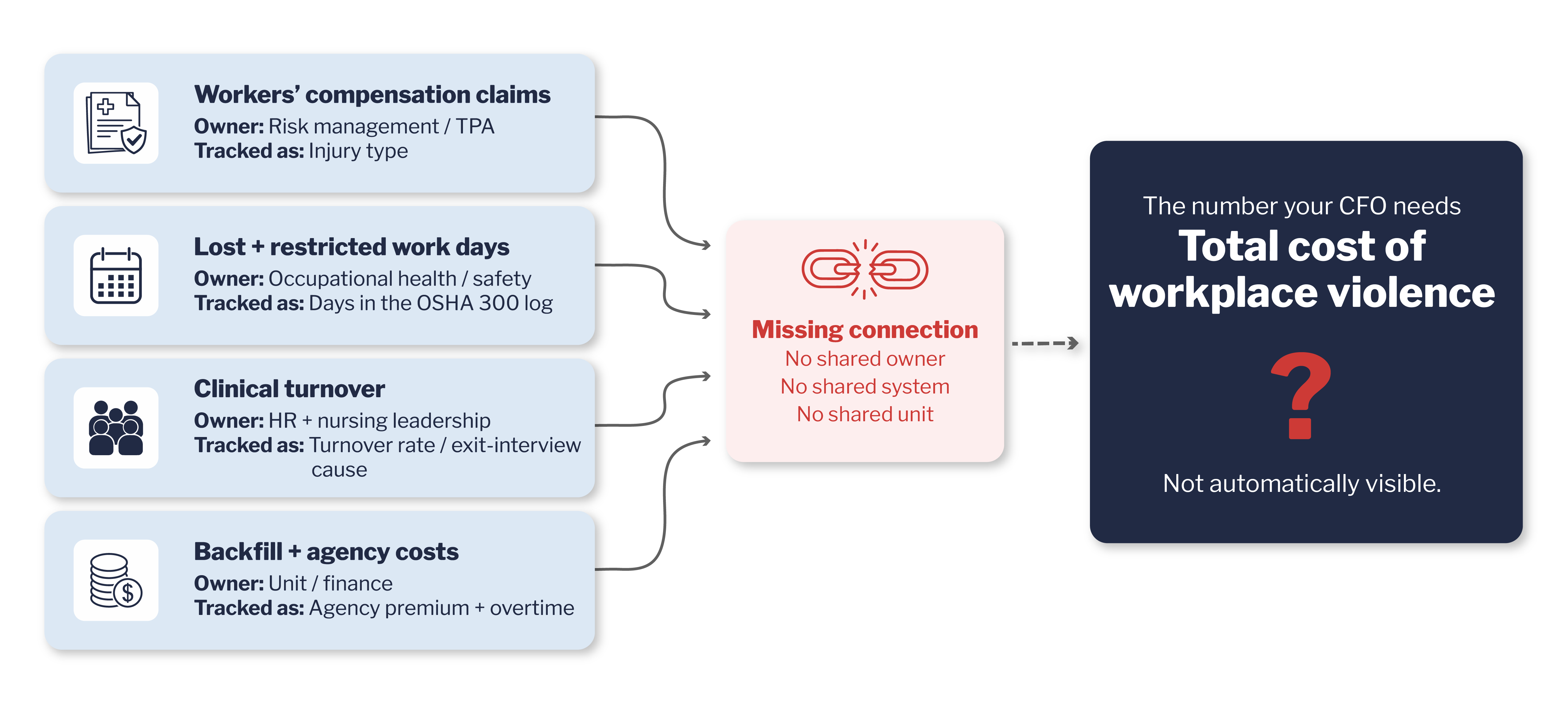
Then build the parts no statute will give you. Prosecution partnerships with your district attorney's office and local law enforcement, worked out before you need them. A reporting culture where staff report the small things because reporting leads somewhere. Training that is practiced, not just completed. And data from your four owners (workers' compensation, OSHA recordables, security events, and clinical events) assembled into one picture your leadership can act on. Every one of those makes a health system safer whether any of these bills passes or not.
The bottom line
Federal legislation will not arrive in time to be your plan, and the version most likely to pass would not require you to plan at all. Build to what binds you today, partner with the people who can prosecute the cases prevention cannot stop, and let Washington catch up to the hospitals that did not wait.
Frequently Asked Questions
Not likely in the 119th Congress. H.R.2531 and S.1232 were referred to committee in April 2025 and have had no hearing, markup, or vote. The bill passed the House in 2019 and 2021, but the Senate never voted on it. Any bill not enacted by January 3, 2027, must be reintroduced in the next Congress and start over.
The Save Healthcare Workers Act (H.R.3178, S.1600) would make knowingly assaulting or intimidating hospital personnel a federal crime and imposes no compliance duties on employers. The Workplace Violence Prevention for Health Care and Social Service Workers Act (H.R.2531, S.1232) would direct OSHA to issue an enforceable standard requiring written prevention plans, training, and recordkeeping.
The AHA strongly supports the Save Healthcare Workers Act, which would make assaulting hospital staff a federal crime. It has opposed the OSHA standard bill, arguing in 2021 that hospitals already have tailored programs, that the mandated standards were not warranted, and that the bill's expedited timeline would deny the public a chance to comment on proposed regulations.
No. OSHA moved its proposed healthcare workplace violence rule, RIN 1218-AD08, to Long-Term Actions in September 2025, with no publication date. OSHA enforces workplace violence hazards through the General Duty Clause, and its 2016 guidance (publication 3148-06R) is voluntary. California has its own enforceable healthcare standard, and 19 states require a written plan.
No. The Joint Commission's NPG.02.04.01, effective January 2026, CMS Conditions of Participation, the OSHA General Duty Clause, and 19 state plan laws already require most of what a federal standard would. A program built to those requirements now will be largely compliant with any future federal standard and, more importantly, will reduce harm today.
Sources
American College of Emergency Physicians. (2025, May 8). Congress takes strong step toward better protections for health care workers [Press release]. https://www.acep.org/news/acep-newsroom-articles/congress-takes-strong-step-toward-better-protections-for-health-care-workers
American Hospital Association. (2021, April 16). House passes workplace violence prevention bill. AHA News. https://www.aha.org/news/headline/2021-04-16-house-passes-workplace-violence-prevention-bill
American Hospital Association. (2025a, May 6). AHA applauds introduction of the Save Healthcare Workers Act [Press release]. https://www.aha.org/press-releases/2025-05-06-aha-applauds-introduction-save-healthcare-workers-act
American Hospital Association. (2025b, May 9). AHA expresses support for Save Healthcare Workers Act. AHA News. https://www.aha.org/news/headline/2025-05-09-aha-expresses-support-save-healthcare-workers-act
American Nurses Association. (2025). Workplace violence issue brief: Hill Day 2025. https://www.nursingworld.org/globalassets/docs/ana/comment-letters/wpv-issue-brief_hill-day-2025-final-kr.pdf
Emergency Nurses Association. (2025, May 7). ENA continues support for bills to combat workplace violence. https://www.ena.org/advocacy/news/ena-continues-support-bills-combat-workplace-violence
Emergency Nurses Association. (2026, April 29). In D.C., emergency nurses push for solutions to ED violence, boarding. https://www.ena.org/advocacy/news/dc-emergency-nurses-push-solutions-ed-violence-boarding
House passes Workplace Violence Prevention for Health Care and Social Services Act. (2021, April 19). Safety+Health. https://www.safetyandhealthmagazine.com/articles/21111-house-passes-workplace-violence-prevention-for-health-care-and-social-services-act
J. J. Keller & Associates. (2025, September 4). OSHA sidelines "Workplace Violence in Health Care and Social Assistance" proposed rule. https://www.jjkeller.com/news/article/OSHA-sidelines-Workplace-Violence-in-Health-Care-and-Social-Assistance-proposed-rule_id-cab4161c-597a-4723-d0a1-d54626913d04
The Joint Commission. (2026). National performance goals effective January 2026 for the hospital program (NPG.02.04.01).
Keller, F. (2021, March 24). Statement in opposition to H.R. 1195 [Statement at Subcommittee on Workforce Protections markup]. U.S. House Committee on Education and Labor. https://edworkforce.house.gov/uploadedfiles/keller_1195_opposition_3.24.21.pdf
National Nurses United. (2025, April 1). Nurses applaud reintroduction of federal legislation to prevent workplace violence [Press release]. https://www.nationalnursesunited.org/press/nurses-applaud-reintroduction-of-federal-legislation-to-prevent-workplace-violence
Save Healthcare Workers Act, H.R. 3178, 119th Cong. (2025). https://www.congress.gov/bill/119th-congress/house-bill/3178
Save Healthcare Workers Act, S. 1600, 119th Cong. (2025). https://www.congress.gov/bill/119th-congress/senate-bill/1600
Workplace Violence Prevention for Health Care and Social Service Workers Act, H.R. 2531, 119th Cong. (2025). https://www.congress.gov/bill/119th-congress/house-bill/2531
Workplace Violence Prevention for Health Care and Social Service Workers Act, S. 1232, 119th Cong. (2025). https://www.congress.gov/bill/119th-congress/senate-bill/1232
If you want help turning your current obligations into a program that would already meet a federal standard, that is a conversation worth having now. Schedule a discovery call.
More from Vistelar
This article is general information about pending legislation and regulatory requirements and is not legal advice. Bill status changes. Confirm current status at congress.gov and anything you plan to rely on with your own counsel.
This blog covers topics that include: Federal Legislation · Workplace Violence · OSHA · Save Healthcare Workers Act · Healthcare Policy · Compliance