Beyond the Data of Workplace Violence:
From Executive Buy-In to Measurable ROI
Summary of 40 minute video:
How UofL Health built a business case that changed the conversation with leadership.
Most workplace violence prevention programs don't stall because leadership doesn't care. They stall at budgeting resources to achieve your goals.
Featured Guest Speaker, Brian Owens, the System Workplace Violence Prevention Manager of UofL Health, shares his story from what his program looked like before, what pushed the team to build a formal business case, and what happened once the financial impact was on the table.
Who Should Watch?
Built for CNOs, COOs, CFOs, safety leaders and workplace violence committee members, and anyone responsible for making the financial case for a workplace violence prevention program.
What Will You Learn?
-
How one health system, UofL Health, transformed workplace violence data into a compelling business case that secured executive buy-in.
-
What the program looked like before the change, including the workplace violence challenges the organization faced and the gaps in its tracking and reporting.
-
The catalyst that prompted the organization to build a formal business case, along with the financial barrier that had previously slowed progress.
-
How connecting hard data and financial impact to the initiative changed the conversation with leadership and helped secure C-suite, including CFO-level, support.
-
The measurable results achieved after the program was implemented, including what changed and what the team found surprising once the data became visible.
-
The unexpected return on investment: how attaching clear numbers to the in initiative made the business case easier to present, support, and defend.
The UofL Success Story
The Problem Isn't the Data — It's the Aggregation
Brian Owens, Workplace Violence Prevention Manager at University of Louisville Health, to walk through exactly how Brian built a financial case for WPV prevention — and how a $7 million figure drove system-wide change at one of Kentucky's largest health systems. University of Louisville Health is a large, complex system: 7 hospitals, 3 medical centers, over 1,800 licensed beds, 250+ physician practices, and a dedicated behavioral health hospital serving suburban, urban, and rural communities, including a Level 1 trauma center and an emergency psychiatric services unit.
Before Brian stepped into his role, the system had been training under CPI (Crisis Prevention Institute) — roughly 9,000 staff in-person and 6,000 online annually. Despite that investment, the system was logging more than four workplace violence events per day, those numbers were believed to be drastically underreported, and staff in high-acuity units didn't feel safe. Experienced nurses were leaving. New hires were hard to retain.
The wake-up call came when a serious incident at a high-acuity facility hit the news and spread on social media. Staff posted their fears publicly. New hires showed up to orientation already hesitant. Leadership felt the cultural damage and Brian was tasked with doing something more than compliance training. He was tasked with building a case.
Building the $7 Million Number
The challenge Brian faced is one most WPV prevention leaders know well: you don't own the data. The financial picture of workplace violence is scattered across workers' compensation, employee health, HR, finance, and legal. No single person has ever pulled it together.
Brian started with the incident reporting system, RL Solutions, which gave him a baseline count of events actually occurring. Then he began meeting with each department to understand what they were tracking and how. He built the full financial picture around four cost categories.
Restricted Work Days and Lost Work Days
Under OSHA standards, every organization already tracks these. What most haven't done is calculate what they cost. At U of L Health, employees on restricted duty receive 70% of their salary. That means every injury puts the organization in the position of paying 70% of a wage while simultaneously needing to cover that person's shift with overtime or agency staff. Multiply that across hundreds of incidents annually, and the numbers compound quickly.
Direct Medical Expenses
When a staff member is injured, a fracture from an assault, a musculoskeletal injury from a physical hold, there are direct medical costs processed through employee health. Brian worked with his team to begin separating WPV-specific claims from other occupational injuries so those costs could be attributed accurately.
Staff Turnover and Recruitment
This is often the most expensive and least visible line item. High-acuity units experiencing frequent violence have high turnover. Replacing a nurse requires sign-on bonuses, agency spend, recruitment costs, and orientation time. Across a system with multiple high-acuity environments, this is one of the largest drivers of total WPV cost.
Legal and OSHA Compliance Costs
OSHA 300 log filings, legal exposure from incidents, and administrative time — often buried in overhead — are directly tied to WPV events. Once attributed correctly, they become part of the financial picture.
When all of it was aggregated for the first time, the number was $7 million annually.
The Executive 'A-Ha' Moment
Brian describes the moment he sat down in front of U of L Health's C-suite and walked them through the cost breakdown, line by line.
-
"The second I put all of those numbers together was the second people understood ... you don't realize how much workplace violence is truly costing your facilities until you aggregate those things together."
-
It wasn't a single simultaneous aha across the whole leadership team. That's an unrealistic expectation. It was persistent advocacy, made more urgent by the high-profile incident, that eventually brought every executive to the same table.
-
"It's not just a number on a screen," Brian said. "It's somebody whose life was really affected by what had happened."
-
The combination of fiscal clarity and human reality is what moved the needle. One without the other often doesn't close the deal.
What Changed After Executive Buy-In
With C-suite support secured, Brian built a program infrastructure that looks very different from what most systems have today.
A dedicated full-time training team
Brian moved from a model of 30 PRN instructors to a four-person full-time team with over 100 combined years of experience in healthcare, law enforcement, and behavioral health. The change in staff reception was immediate.
Vistelar built into new hire orientation
Every new hire, regardless of facility or role, now goes through workplace violence prevention training before their first day on the floor. Inpatient and emergency department staff meet Brian's team first.
Monthly reinforcement in behavioral health
Behavioral health staff now receive 30 minutes of de-escalation and 30 minutes of physical skills training every single month — on top of their annual recertification. Daily safety debriefs keep incident patterns visible in real time.
System-wide workplace safety committees
Each facility has a committee — monthly for most, daily at the behavioral hospital — integrating post-incident debrief, trend review, and policy development with frontline staff at the table.
Measurable Results
Brian is careful about projections in a variable cost environment, but the early results from the transition to Vistelar are concrete.
The shift to Vistelar's fixed-cost licensing model has already saved approximately $250,000 annually — before counting any reduction in incidents or injuries. That's purely the program cost differential.
Brian's target for the first full year is a 10% reduction in both staff turnover and restricted/lost work days. Based on their $7 million baseline, a 10% improvement represents over $1 million in recoverable costs in year one.
The results Brian talks about with the most conviction, though, aren't financial. Staff became champions. Security staff who questioned every CPI class are now asking "what else can we do?" Behavioral staff are becoming vocal advocates. And frontline staff are no longer accepting assault as part of the job, they're reporting more, pressing charges more, and feeling supported in doing both.
In Kentucky, that cultural shift has a legislative counterpart. Three years ago, assaulting a healthcare worker was a misdemeanor. Today, it's a felony, an outcome U of L Health advocated for alongside the Kentucky Hospital Association and nurse representatives who traveled to Frankfort to push for the change.
Six Steps to Build Your Own Business Case
Brian closed the webinar with six action items for any safety leader or administrator watching. These aren't theoretical. It's the roadmap he actually used.
- Quantify your true cost. Start by asking what WPV is actually costing your organization. Don't estimate, aggregate. Work through each cost category and build the real number.
- Benchmark your position. Use NDNQI, OSHA data, and peer organizations to understand where your system sits relative to comparators. Benchmarking gives your cost data external context.
- Align your stakeholders. Your COO, CFO, and CNO need to understand what data is being collected, why, and how it's being tracked. Get them invested in the metrics before you bring the full business case.
- Model the investment. Build a 3-to-5-year vision for your program. Show leadership not just what you need now, but where you're going — and what return they can expect.
- Build your business case. Combine true cost data, benchmark comparison, and investment model into a presentation leadership can act on.
- Present it as a decision. Not a report — a choice. Here is what WPV is costing us. Here is what a structured prevention investment changes. Here is the expected ROI. What are we going to do?
UofL Health Story
Frequently Asked Questions
How do you calculate the true cost of workplace violence in a hospital?
The most accurate approach is to aggregate costs across four categories: restricted and lost work days, direct medical expenses from staff injuries, staff turnover and recruitment costs driven by WPV-related departures, and legal/OSHA compliance costs.
Here's a resource to help you put together those numbers: Vistelar Workplace Violence Impact & Trainin ROI Calculator
What is a realistic annual WPV cost for a health system?
It depends on system size and acuity mix. University of Louisville Health — a 7-hospital system with 1,800 licensed beds — estimated $7 million annually once all cost categories were aggregated. Brian Owens notes that a smaller community hospital might calculate $300,000 — but that figure represents the same percentage of resources lost. The dollar amount scales with system size; the proportional impact doesn't.
Where does workplace violence data come from inside a health system?
It's typically spread across four areas: the internal incident reporting system (RL Solutions is common), employee health (medical claims and restricted duty), HR and finance (turnover and recruitment costs), and workers' compensation or risk management (claims data). No single team owns all of it, which is why it has to be actively aggregated rather than pulled from one report.
Why doesn't the moral argument alone move healthcare executives?
It's not that executives don't care — they do. But they're responsible for dozens of operational priorities simultaneously, and without a fiscal picture, WPV competes for budget against initiatives that already have financial justification. The moral argument and the financial argument work together. Brian found that once the $7 million figure was on the table, the human story of injured staff landed differently. The number gave executives something concrete to act on.
What does "fixed-cost" mean in the context of a WPV prevention program?
A fixed-cost model means the organization pays a set licensing fee for the training program regardless of how many sessions or staff go through it. The alternative — variable cost — means paying per person, per class, or per certification, which makes budgeting unpredictable and can actually discourage training volume. U of L Health's switch to Vistelar's fixed-cost model alone saved approximately $250,000 annually and removed uncertainty from the budget process.
How long does it take to see measurable ROI from a WPV prevention program?
Brian's benchmark for year one is a 10% reduction in turnover and restricted/lost work days — which at U of L Health's baseline would represent over $1 million in savings. Some financial benefits are immediate (fixed-cost program savings, reduced agency spend from lower turnover). Others accumulate over time as training reaches critical mass and incident frequency declines. Cultural indicators — staff reporting more, pressing charges more, expressing confidence in their training — often shift faster than financial metrics.
How do you get C-suite buy-in for workplace violence prevention investment?
Brian's path: build the aggregated cost picture first, then bring it to executives alongside the human story. The data alone is necessary but not always sufficient. What works is showing the full cost of inaction — $7 million that nobody had ever seen in one place — and pairing it with a model of what structured prevention investment returns over 3 to 5 years. Present it as a decision, not a briefing.
How do I access the Calculator mentioned?
Vistelar Workplace Violence Impact & Trainin ROI Calculator
Built in partnership with Brian Owens and University of Louisville Health, the Vistelar ROI Calculator lets you privately enter your own organization's data across the four cost categories and see your baseline cost, a side-by-side investment comparison, and a five-year return projection — the same framework Brian used to build the $7 million case.
I feel overwhelmed on where to start. How do I request the free consulting to put together a business case?
Build Your Business Case Help Free Consultations
Want to work through your numbers with someone from the Vistelar team? We offer a complimentary 20-minute session to help you identify cost data sources inside your organization and begin building your business case. Book your free session now.
Key Takeaways: Your Role Saves Lives
- Observation = protection
- Communication = trust
- Documentation = safety + legal defense
- Emergency readiness + self-care = sustained effectiveness
- “When you protect yourself, you protect your patients.”
Downloadable Resources:
🔗 Patient Care Safety Monitor Simulation — Debrief Guide
🔗 Patient Care Safety Monitor — Safety Pledge
Related Three-Part Blog Series:
Part 1: Understanding the Role of Patient Care Safety Monitors
Part 2: Beyond the Chart—How Communication & Documentation Save Lives
Part 3:Seconds Matter—Emergency Response, Self-Care, and Staying Ready
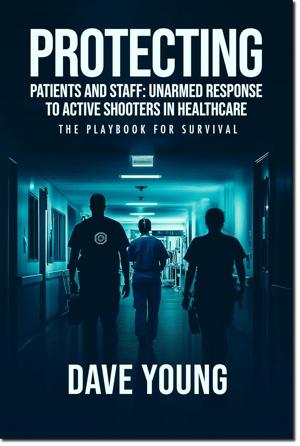
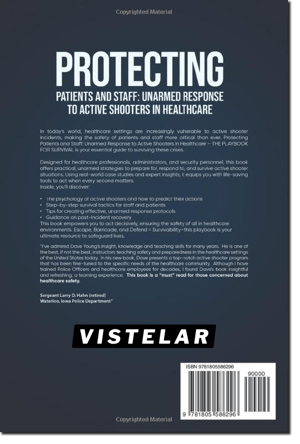
To get Dave Young’s book, Protecting | Patients and Staff: Unarmed Response to Active Shooters in Healthcare | The Playbook for Survival, click on the link to purchase it for a $5 discount and FREE shipping (normally $24.97 + cost of shipping). To get the full discount, simply choose the shipping option shown and it will automatically apply to the final price.