When Security and Clinical Teams Align:
A Better Approach to Workplace Violence Prevention
Security and Clinical Teams Share the Same Risk.
Most Still Have No Shared Plan.
Security and clinical teams work under the same roof and carry the same risk. In most healthcare organizations, they still operate from separate playbooks, with no shared language for identifying a threat and no shared protocol for responding to one.
This webinar gives healthcare operations, clinical, and security leaders a practical framework for closing that gap: cross-functional protocols, faster warning-sign communication between frontline staff and security, and an integrated response model built to reduce how severe an incident becomes, not just how often one happens.
Aligning two departments that report to different leaders, use different terminology, and answer to different regulators does not happen by accident. It takes a deliberate framework. This session outlines one, with real-world examples and specific steps to bring back to your own organization.
Why Does It Matter?
Healthcare organizations that put an integrated, prevention-first response in place have measured results. One children's hospital's integrated behavioral escalation response team recorded 374 activations in its first 12 months, alongside a 20% to 64% decrease in assaults and a 50% decrease in mechanical restraint use. (Source: Children's Nebraska, cited in Vistelar's library.)
What Will You Learn?
By the end of this webinar, participants will be able to:
- Apply a cross-training approach that gives clinical and security staff a common language and shared de-escalation protocols.
- Use a practical framework for aligning security and clinical teams around one workplace violence prevention strategy.
- Improve early warning-sign identification and communication between frontline clinical staff and security personnel.
- Point to real-world examples of integrated response models and their measurable impact on incident outcomes.
- Start the security-clinical alignment conversation inside their own organization, with specific next steps.
Who Should Watch?
- Operations and safety leaders responsible for their organization's workplace violence prevention plan, who need clinical and security functions working from one playbook instead of two.
- Clinical leadership — nursing leadership, nursing education, and clinical professional development — who manage frontline staff through an escalating situation and need faster, clearer coordination with security.
- Security and risk leadership accountable for incident response and post-incident review, who need clinical teams flagging warning signs earlier.
Meet the Speakers

Sarah-Marie Baumgartner
Emergency Department Nurse, Host of The Security Nurse Podcast
Sarah‑Marie is an emergency department nurse with more than 20 years of clinical experience and the host of The Security Nurse Podcast.
She amplifies conversations on healthcare workplace violence prevention and holistic care, advocating for safer, more supportive environments for patients and staff. As an educator, she shares practical insights and compelling stories that connect safety, health, and human connection—encouraging learners to think creatively and beyond the expected.

Daniel Oster, MA
Director of Client Success at Vistelar
Daniel is a physical security and public safety leader with nearly two decades of experience in law enforcement, security training, and conflict de-escalation. He holds a Master's degree in Criminology and Criminal Justice, is a certified Use of Force Instructor, and has completed FBI Crisis Negotiation training. He is Director of Client Success at Vistelar, where he helps partners build scalable and sustainable workplace violence prevention programs.
Key Takeaways: Your Role Saves Lives
- Observation = protection
- Communication = trust
- Documentation = safety + legal defense
- Emergency readiness + self-care = sustained effectiveness
- “When you protect yourself, you protect your patients.”
Downloadable Resources:
🔗 Patient Care Safety Monitor Simulation — Debrief Guide
🔗 Patient Care Safety Monitor — Safety Pledge
Related Three-Part Blog Series:
Part 1: Understanding the Role of Patient Care Safety Monitors
Part 2: Beyond the Chart—How Communication & Documentation Save Lives
Part 3:Seconds Matter—Emergency Response, Self-Care, and Staying Ready
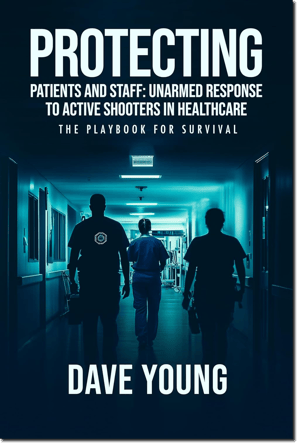
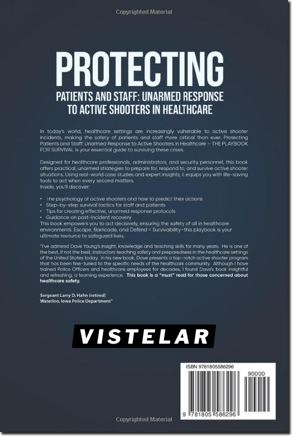
To get Dave Young’s book, Protecting | Patients and Staff: Unarmed Response to Active Shooters in Healthcare | The Playbook for Survival, click on the link to purchase it for a $5 discount and FREE shipping (normally $24.97 + cost of shipping). To get the full discount, simply choose the shipping option shown and it will automatically apply to the final price.